
Chemicals at Work: Storage, Labeling and Safety
Chemical management in companies includes secure storage, GHS/CLP labeling, safety data sheets (SDS) and worker training. This article presents regulatory obligations.
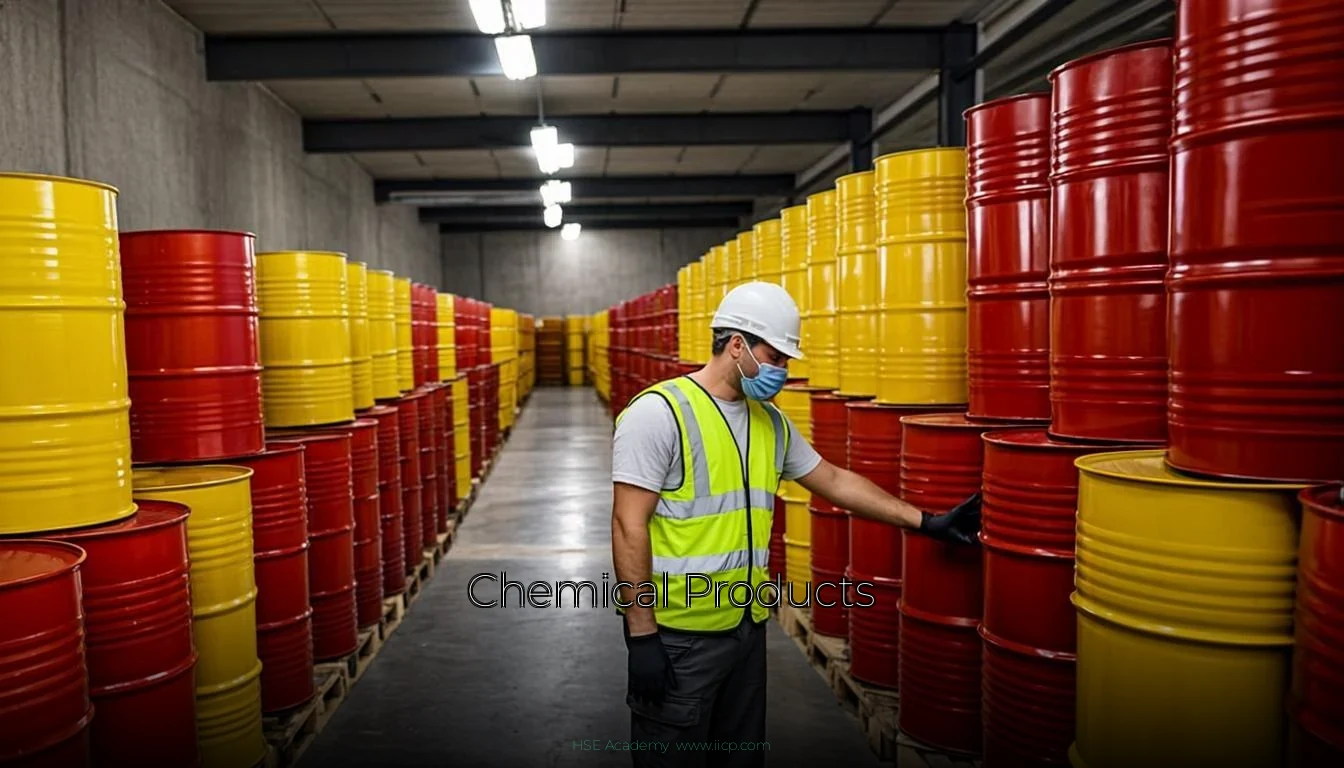
Chemicals at Work: Storage, Labelling and Safety
Chemical products are used in many professional environments, including industrial facilities, laboratories, workshops, healthcare establishments and cleaning services. Their use can expose workers to risks such as poisoning, burns, fires, explosions and environmental contamination.
Effective chemical risk management relies on identifying hazards, correctly labelling products, ensuring safe storage, providing appropriate protective equipment and training workers in safe handling procedures.
1. Identify chemical hazards
Before using a chemical product, employers and workers should identify its hazards and assess the risks associated with its use, storage and disposal.
The main hazards include:
- Health hazards: poisoning, skin irritation, chemical burns, respiratory problems and long-term health effects.
- Physical hazards: fire, explosion, dangerous reactions and pressure-related accidents.
- Environmental hazards: contamination of soil, water and ecosystems.
The assessment should consider the product's properties, quantity, method of use, exposure routes, workplace conditions and the possibility of accidental spills or incompatible chemical reactions.
2. Understand chemical hazard pictograms
The Globally Harmonized System of Classification and Labelling of Chemicals (GHS), known in French as SGH, establishes an international framework for communicating chemical hazards. Its pictograms help users identify specific types of danger.
The European Union's CLP Regulation implements classification, labelling and packaging requirements within its own legal framework. It should not automatically be treated as Moroccan law.
Main GHS hazard pictograms
**Exploding bomb** Indicates explosive substances or mixtures and certain self-reactive substances or organic peroxides that may present an explosion hazard.
</box>
  Indicates flammable products and certain substances capable of igniting or contributing to fire under specified conditions.
</box>
  Identifies oxidizing substances that may cause or intensify a fire.
</box>
  Indicates gases under pressure, which may present risks associated with pressure, cold burns or heating.
</box>
  Indicates products that can cause severe skin burns, serious eye damage or corrosion of metals.
</box>
  Indicates acute toxicity that may cause serious harm or death following exposure.
</box>
  May indicate skin or eye irritation, skin sensitisation, harmful acute toxicity or certain other health effects.
</box>
  Indicates certain serious or chronic health hazards, such as carcinogenicity, respiratory sensitisation or specific organ toxicity.
</box>
  Indicates hazards to the aquatic environment.
</box>
The applicable pictograms and label information depend on the classification of the specific product. Workers should never rely on pictograms alone; they should also consult the product label and safety data sheet.
3. Chemical labelling and safety data sheets
Every chemical container should be clearly identifiable. Where applicable, the label should provide the product identifier, supplier information, hazard pictograms, signal word, hazard statements and precautionary statements.
Chemical products should not be transferred into unlabelled containers. If a product is transferred to another container, the workplace procedure must ensure that the container remains correctly identified and that the necessary hazard information is available.
Safety data sheets
A safety data sheet (SDS) provides detailed information on a chemical product's hazards and safe use. In frameworks that prescribe the standard format, it contains 16 sections covering topics such as:
- Identification of the substance or mixture and the supplier.
- Hazard identification and composition.
- First-aid and firefighting measures.
- Accidental release measures and handling.
- Storage, exposure controls and personal protective equipment.
- Physical and chemical properties, stability and reactivity.
- Toxicological and ecological information.
- Disposal, transport and regulatory information.
Employers should make relevant safety data sheets accessible to workers and ensure that the information is understood. The precise legal requirements depend on the applicable national rules and the circumstances in which the product is supplied or used.
4. Safe storage of chemical products
Chemical storage must prevent leaks, accidental exposure, fire, dangerous reactions and environmental contamination.
Good storage practices
- Store products in suitable, compatible and clearly identified containers.
- Keep containers closed when they are not in use.
- Separate incompatible chemicals according to their properties and the safety data sheet.
- Store flammable products away from ignition sources and other incompatible materials.
- Secure gas cylinders against falling and follow the supplier's storage instructions.
- Provide suitable ventilation based on the products, quantities and potential exposure.
- Use appropriate secondary containment where spills could contaminate floors, drains or the environment.
- Restrict access to authorised personnel when necessary.
- Keep emergency equipment and escape routes accessible.
- Inspect containers, shelves, storage areas and containment systems regularly.
Segregation of incompatible chemicals
Some chemicals may react dangerously when mixed. For example, certain oxidisers can intensify fires, while incompatible acids and bases may react violently. Some products can release toxic gases when mixed with other substances.
Storage arrangements should therefore be based on compatibility information, not simply on product names or alphabetical order.
Ventilation and containment
Ventilation must be designed according to the chemical's physical and toxicological properties, the quantities stored, the potential for vapour or gas release, and the characteristics of the storage area.
There is no single ventilation arrangement suitable for every chemical store. Where required by the risk assessment, suitable spill containment should prevent released liquids from reaching drains or sensitive areas.
A fixed containment ratio, such as 110% of the largest container, should not be presented as a universal legal requirement in Morocco without identifying the specific regulation, technical standard or contractual requirement that applies.
Specialised flammable-liquid safety cabinets, including those covered by EN 14470-1, have a defined scope. Their applicability must be assessed against the installation and the relevant requirements; the standard should not automatically be described as a general Moroccan legal obligation.
5. Personal protective equipment and safe handling
Personal protective equipment (PPE) should be selected according to the hazards identified in the risk assessment and the product's safety data sheet.
Depending on the task, PPE may include:
- Chemical-resistant gloves compatible with the product.
- Safety goggles or a suitable face shield.
- Protective clothing and footwear.
- Respiratory protective equipment where required by the exposure assessment.
PPE does not replace safer work methods, appropriate engineering controls or adequate ventilation. Employers should also provide suitable equipment, instructions, training and supervision.
Workers should avoid eating, drinking or smoking in chemical handling areas, wash their hands after handling products and follow established hygiene procedures.
Chemical products must never be mixed unless the procedure has been specifically assessed and authorised.
6. Spill response and emergency preparedness
A chemical spill can cause immediate harm through inhalation, skin contact, fire or environmental release. Each workplace should have an emergency procedure suited to the chemicals present and the potential severity of an incident.
The procedure should specify:
- How to raise the alarm and secure the affected area.
- When workers must evacuate and how to prevent unauthorised access.
- Who is authorised and trained to intervene.
- Which spill-control materials and protective equipment are suitable.
- How to prevent contamination of drains and the environment when this can be done safely.
- How to collect, identify and manage contaminated absorbents and other resulting waste.
Workers should not attempt to clean up an unknown, highly toxic, reactive or otherwise dangerous spill without the necessary training, equipment and authorisation.
Emergency arrangements should include appropriate first-aid measures, access to relevant safety data sheets and procedures for contacting emergency services.
7. Chemical waste management in Morocco
Chemical waste must be identified and managed according to its nature, hazards and applicable legal classification. It should not automatically be mixed with ordinary household or workplace waste.
In Morocco, Law No. 28-00 on waste management and disposal, together with its implementing regulations, forms part of the national legal framework. Decrees No. 2-07-253 and No. 2-14-85 are relevant to aspects of waste classification and hazardous waste management.
Businesses should identify their obligations concerning waste classification, storage, traceability, transport and treatment, according to the waste concerned and their role in the waste-management chain.
Waste should be kept in suitable, identified containers and transferred through authorised channels where required. The applicable requirements should be verified against the current official texts and the specific waste category.
French administrative documents, such as the bordereau de suivi des déchets used under French law, should not automatically be presented as mandatory Moroccan procedures.
8. Regulatory framework and employer responsibilities
In Morocco, the employer's general duties concerning workplace health and safety are addressed in the Labour Code, Law No. 65-99. Other requirements may apply depending on the chemical, industry, activity, exposure scenario and environmental impact.
The relevant regulatory framework may include:
- General occupational health and safety obligations.
- Rules concerning specific chemical substances or occupational exposures.
- Requirements governing hazardous waste and environmental protection.
- Applicable Moroccan standards and sector-specific technical requirements.
- Additional foreign requirements where their legal scope applies to the organisation, product or activity.
The United Nations GHS is an international framework, not by itself a single directly applicable law in every country. Similarly, European CLP and REACH requirements apply according to their respective legal scope and the organisation's role; they should not be assumed to apply to every Moroccan business merely because it uses or exports a chemical product.
Employers should identify the texts applicable to their own activities and keep evidence of the measures taken to control chemical risks.
9. Practical checklist for chemical safety
A periodic inspection can help identify gaps before they cause an incident.
- Chemical products are inventoried and identified.
- Relevant labels and safety data sheets are available.
- Incompatible products are segregated.
- Containers are closed, intact and suitable for their contents.
- Storage conditions and ventilation are appropriate.
- Spill-control materials and emergency equipment are available.
- Workers are trained in safe handling and emergency procedures.
- PPE is suitable, available and correctly maintained.
- Chemical waste is identified, stored and transferred appropriately.
- Inspections, incidents and corrective actions are documented.
Conclusion
Chemical safety requires a systematic approach combining hazard identification, risk assessment, correct labelling, compatible storage, worker training, suitable protective equipment and responsible waste management.
For Moroccan organisations, the key is to distinguish general occupational safety duties from specific legal, environmental and technical requirements. Each workplace should verify the rules applicable to its activities and implement preventive measures proportionate to the risks.
Sources and further reading
- International Labour Organization (ILO) — Moroccan occupational safety and health legislation: https://webapps.ilo.org/static/french/protection/safework/cis/legosh/mar/index.htm
- United Nations Economic Commission for Europe (UNECE) — Globally Harmonized System of Classification and Labelling of Chemicals, Revision 10: https://unece.org/transport/documents/2023/07/standards/ghs-rev10
- Moroccan Ministry of Energy Transition and Sustainable Development — Waste management and legislation: https://environnement.gov.ma/fr/dechets?id=112