Circular Economy: Turning Waste into a Resource in Companies
The circular economy aims to minimize waste and maximize resource reuse. In QHSE companies, it applies to recycling, reuse, and eco-design. An essential complement to ISO 14001.
Circular Economy: Transforming Waste into a Resource in Business
The circular economy aims to minimize waste and maximize resource reuse. In QHSE business, it applies to recycling, reuse, and eco-design. An essential complement to ISO 14001.
The circular economy is an economic model that aims to minimize waste and maximize the reuse, recycling, and valorization of resources throughout the product life cycle. Facing resource depletion, rising raw material costs, and climate challenges, this model is established as an essential complement to the ISO 14001:2015 environmental management system in QHSE business.
Definition
Contrary to the linear model "extract → manufacture → consume → discard," the circular economy organizes material and energy flows in closed loops. The objective is to maintain the value of products, components, and materials in the economic circuit for as long as possible, while reducing environmental impacts.
The 3Rs: Reduce, Reuse, Recycle
The 3R principle structures the hierarchy of actions:
- Reduce the quantity and hazardousness of waste at the source (more material-efficient design, eco-design, responsible purchasing). This is the most effective action.
- Reuse products or components for the same use (reuse) or another use (repurposing). Reuse preserves the utility value without material transformation.
- Recycle materials: grinding, separation, remelting, repelletizing, regeneration. Recycling consumes energy but avoids the extraction of virgin raw materials.
Application in Business
In QHSE business, the circular economy translates into concrete actions:
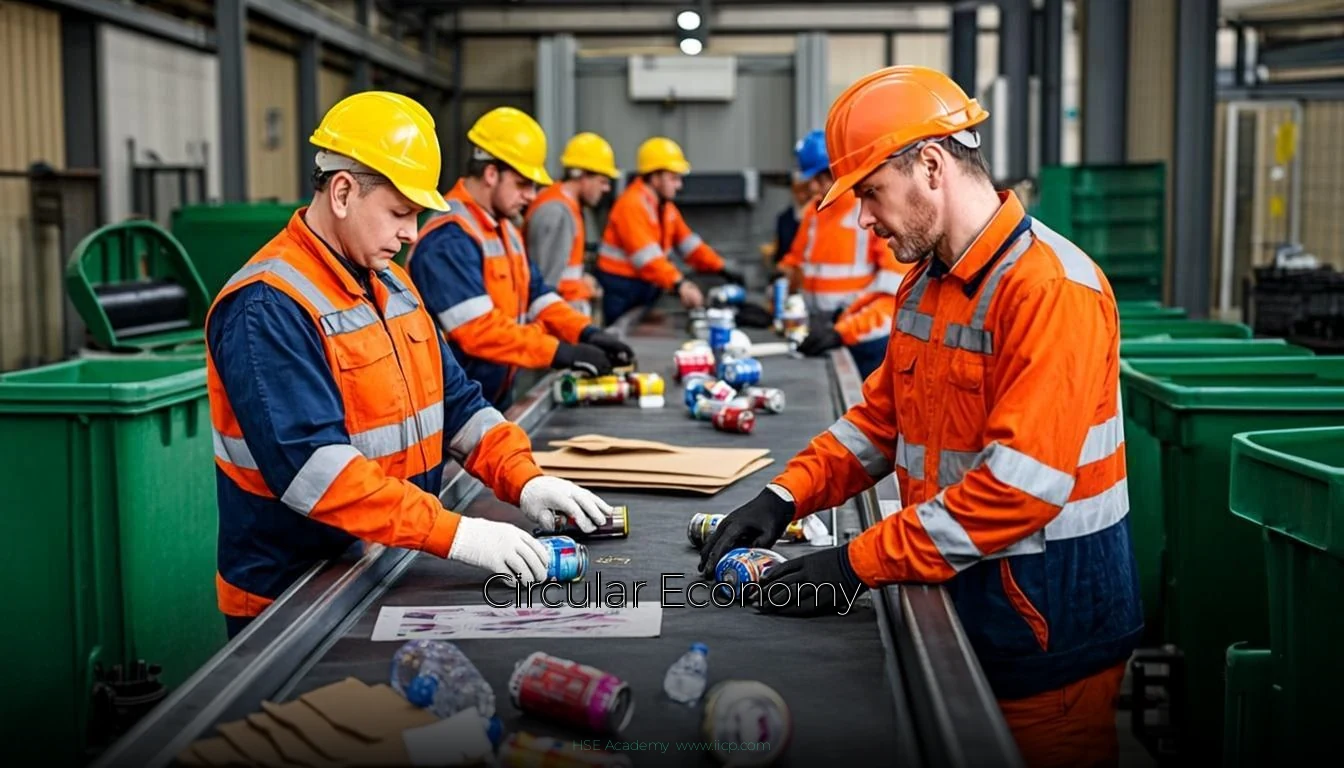
- Management of non-hazardous industrial waste (NIW) and waste electrical and electronic equipment (WEEE): sorting, selective collection, approved channels.
- Material valorization of industrial waste: plastics, metals, glass, paper-cardboard.
- Organic valorization of food and agro-industrial waste: anaerobic digestion (biogas), composting.
- By-products: a waste can become the raw material for another activity (territorial industrial ecology, inter-company synergies).
- Functional economy: selling a service (rental, usage) rather than a product (e.g., furniture rental, printing as a service).
Link with ISO 14001
The ISO 14001:2015 standard requires the organization to identify its significant environmental aspects, with waste production being a major one. The circular economy directly addresses the operational and improvement requirements of ISO 14001:
- Operational control of waste and effluents.
- Improvement objectives for the valorization rate.
- Communication with interested parties (clients, local authorities, extended producer responsibility schemes).
Eco-design
Eco-design integrates environmental criteria from the product design phase, anticipating its end-of-life: disassembly, modularity, recyclable materials, lifespan, repair, upgrade. The standards ISO 14006:2020 (guidelines for eco-design) and ISO 14040:2006 / ISO 14044:2006 (life cycle assessment) provide the methodological framework.
Application in Morocco
In Morocco, the National Program for the Management of Household and Similar Waste and Law No. 28-00 relating to the management and elimination of waste (Dahir 1-06-153 of 22/11/2006) regulate the sector. Industrial companies are subject to the obligation of an internal waste management plan. The development of valorization channels (plastic, paper, metal, organic matter) represents a significant source of jobs and raw material savings.
Sources et références
-
Maroc — Loi n° 28-00 relative à la gestion et à l'élimination des déchets (Dahir 1-06-153 du 22/11/2006) Secrétariat général du gouvernement : https://www.sgg.gov.ma/Legislation.aspx
-
Code du travail marocain (Loi n° 65-99), Titre IV — articles 281 et suivants (principes généraux applicables) ILO NATLEX : https://natlex.ilo.org/dyn/natlex2/r/natlex/fe/details?p3_isn=67319
-
ISO 14001:2015 — Environmental management systems https://www.iso.org/standard/60857.html