CSR and Sustainable Development in Morocco: HSE Issues and Opportunities
Corporate Social Responsibility (CSR) in Morocco is developing with the National CSR Charter. For HSE companies, it is an opportunity to integrate environment, social and governance.
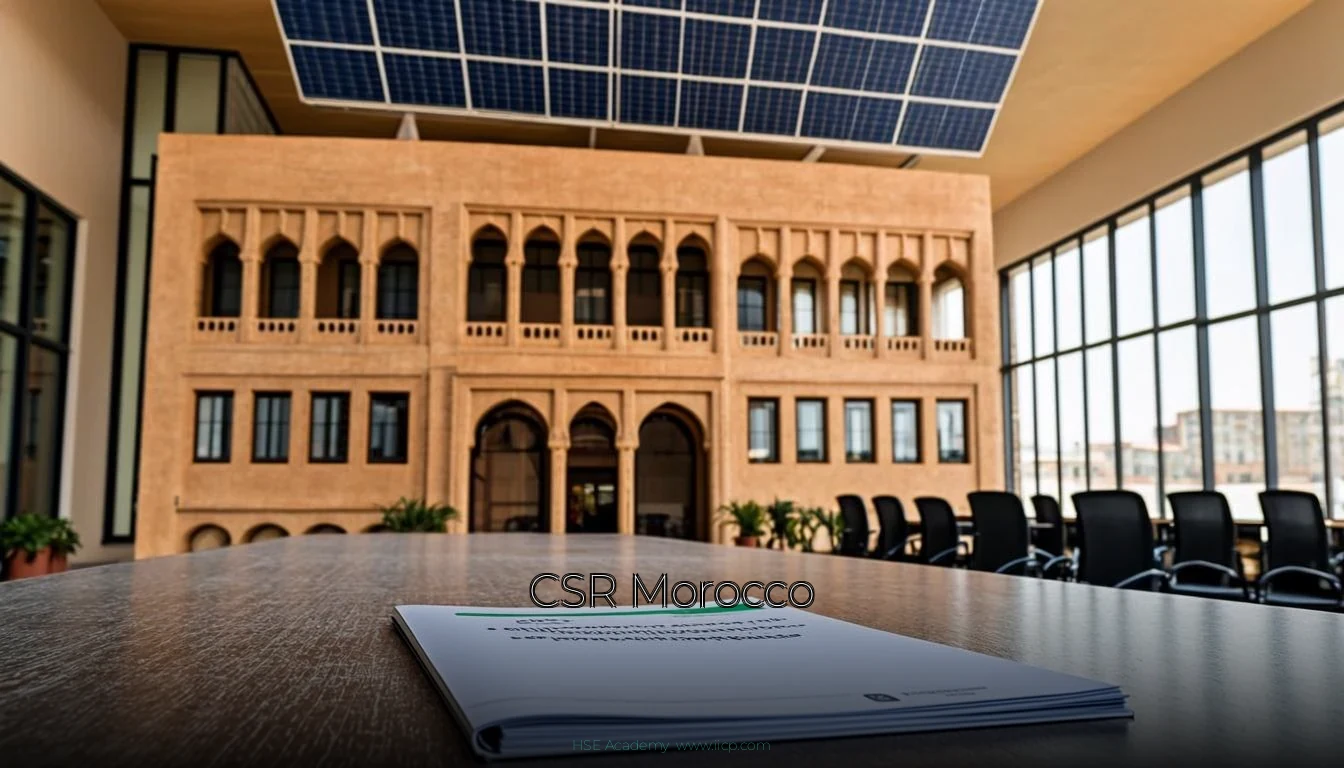
CSR and Sustainable Development in Morocco: QHSE Challenges and Opportunities
Corporate Social Responsibility (CSR) in Morocco is developing with the National CSR Charter. For QHSE companies, it is an opportunity to integrate environment, social, and governance.
Corporate Social Responsibility (CSR) refers to the voluntary integration of social, environmental, and economic concerns into the activities and relationships of companies with their stakeholders.
Moroccan Context
In Morocco, CSR has been structured around the National CSR Charter, launched by the CGEM (General Confederation of Moroccan Enterprises) in December 2017. It is based on 9 areas of commitment (governance, human rights, labor relations, environment, etc.). Concurrently, the Framework Law No. 12-90 on the Environment establishes a national framework for sustainable development.
The Three Pillars of CSR
- Environment: carbon footprint, water, waste, biodiversity;
- Social: working conditions, equality, local impact, responsible purchasing;
- Governance / Economy: transparency, ethics, economic performance, anti-corruption.
Tools and Standards
- ISO 26000:2010: Guidelines on social responsibility (a non-certifiable international standard);
- ESG Reporting: Environmental, Social, and Governance (ESG) indicators;
- GRI Standards: Global framework for sustainability reporting (Global Reporting Initiative);
- SDGs / SDGs: The 17 United Nations Sustainable Development Goals (2030 Agenda).
Benefits for the Company
- Brand image and reputation;
- Talent attraction (younger generations are sensitive);
- Access to international markets (Europe, the EU requires CSR proof — CSRD, due diligence);
- Cost reduction (energy, water, waste);
- Access to green finance (Green bonds, ESG loans).
Link with the QHSE System
The integrated management system (IMS) constitutes the operational foundation of CSR:
- ISO 14001:2015 — Environmental management;
- ISO 45001:2018 — Occupational health and safety;
- ISO 9001:2015 — Quality management;
- ISO 50001:2018 — Energy management (complementary).
A QHSE-certified company can easily build credible CSR reporting from data already being tracked (emissions, accidents, training rates, etc.).
Pioneer Sectors in Morocco
The sectors most engaged in CSR in Morocco are: the banking sector (signatories of the Principles for Responsible Banking), OCP (Office Chérifien des Phosphates), the energy sector (Masen, ONEE), telecommunications, and the automotive industry (Renault Tanger, Stellantis Kénitra).
Sources et références
-
Code du travail marocain (Loi n° 65-99), Titre IV — articles 281 et suivants (principes généraux de prévention, en cohérence avec la question centrale « Relations et conditions de travail » d'ISO 26000) ILO NATLEX : https://natlex.ilo.org/dyn/natlex2/r/natlex/fe/details?p3_isn=67319
-
ISO 26000:2010 — Guidance on social responsibility https://www.iso.org/standard/42546.html
-
CGEM — Charte Nationale de la RSE (lancée en décembre 2017, 9 domaines d'engagement) https://www.cgem.ma