Industrial Air Emissions: Regulations and Reduction
Industrial air emissions (VOCs, NOx, SOx, dust) are regulated. Filters, scrubbers and emission standards form a core part of QHSE environmental management.
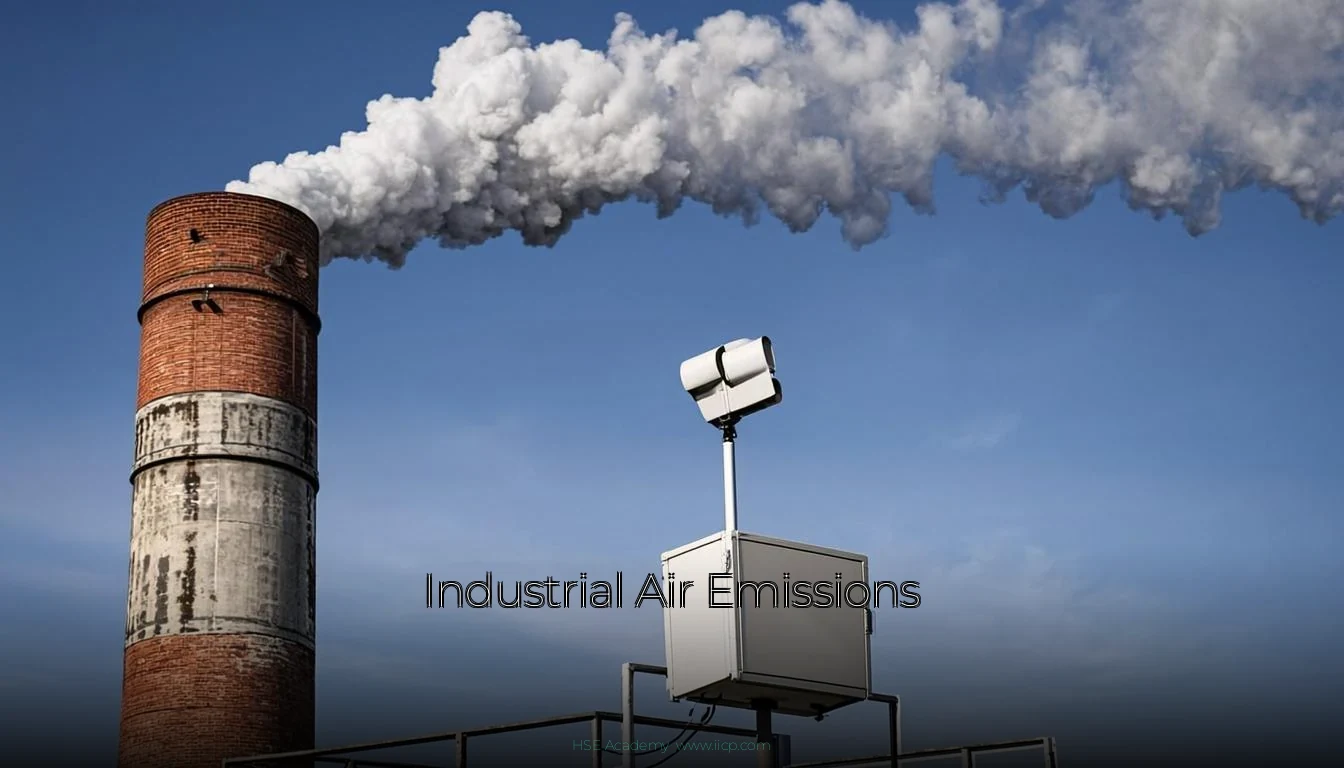
Industrial Atmospheric Emissions: Regulation and Reduction
Industrial atmospheric emissions (VOCs, NOx, SOx, dust) are regulated. Filters, dust collectors, and emission standards are part of QHSE environmental management.
Industrial atmospheric emissions refer to pollutants released into the air by production facilities: volatile organic compounds (VOCs), nitrogen oxides (NOx), sulfur oxides (SOx), dust, and particles. Their control is a cornerstone of QHSE environmental management and a regulatory requirement in almost all countries.
Types of Atmospheric Pollutants
- VOCs (Volatile Organic Compounds): Solvents, paints, adhesives, hydrocarbons. From the chemical industry, printing, degassing, metal cleaning.
- NOx (Nitrogen Oxides, NO and NO2): From high-temperature combustion (boilers, engines, turbines).
- SOx (Sulfur Oxides, mainly SO2): From the combustion of coal and heavy fuel oil containing sulfur.
- Dust and Particles (PM10, PM2.5): From grinding, crushing, material storage, welding, sawing.
- Heavy Metals and Specific Gases: Lead, mercury, HCl, HF, NH3, dioxins.
Industrial Sources
The main emitting activities are:
- Thermal power plants and boiler houses (NOx, SOx, VOCs).
- Chemical and petrochemical industries (VOCs, halogenated compounds).
- Painting, varnishing, solvent use (VOCs).
- Steel, cement, glass industries (dust, NOx, SOx).
- Welding, thermal cutting (metal fumes, ozone).
- Agri-food industry (organic dust, odors).
Reduction Techniques
Several technologies exist depending on the pollutant and flow rate:
- Bag Filters: Dust capture by filtering media, >99% efficiency on PM10.
- Electrostatic Precipitators (ESP): Ionization of particles and collection on plates. High capacity, hot gas streams.
- Scrubbers: Washing by spraying water or a basic solution to trap SOx, HCl, dust.
- Thermal Regeneration (RTO): High-temperature oxidation (800°C) of VOCs with heat recovery.
- Activated Carbon: Adsorption of VOCs and odors.
- Flue Gas Desulfurization (FGD): Removal of SO2.
- SCR (Selective Catalytic Reduction): Reduction of NOx by injecting ammonia over a catalyst.
Regulation
In Morocco, atmospheric emissions are governed by the Framework Law No. 12-90 on the Environment (not to be confused with Law No. 12-03 on Environmental Impact Assessments) and the atmospheric emission standards set by the Ministry of Energy Transition and Sustainable Development, in line with WHO guideline values. Classified facilities (the Moroccan equivalent of French ICPEs — Installations Classified for the Protection of the Environment) must have an authorization, a monitoring program, and an annual emissions declaration. The Dahir of August 25, 1914, concerning unhygienic, inconvenient, or dangerous establishments also serves as a historical reference.
Link to ISO 14001
The ISO 14001:2015 standard requires the identification of significant environmental aspects, including atmospheric emissions, and the establishment of reduction objectives. The PDCA (Plan-Do-Check-Act) cycle guides the continuous improvement of environmental performance.
Sources industrielles
Les principales activités émettrices sont :
-
Centrales thermiques et chaufferies (NOx, SOx, COV).
-
Industrie chimique et pétrochimique (COV, composés halogénés).