Industrial Soil Pollution: Prevention and Contaminated Sites
Industrial soil pollution (heavy metals, hydrocarbons, solvents) threatens groundwater and health. Prevention, diagnosis and rehabilitation of contaminated sites are essential in HSE.
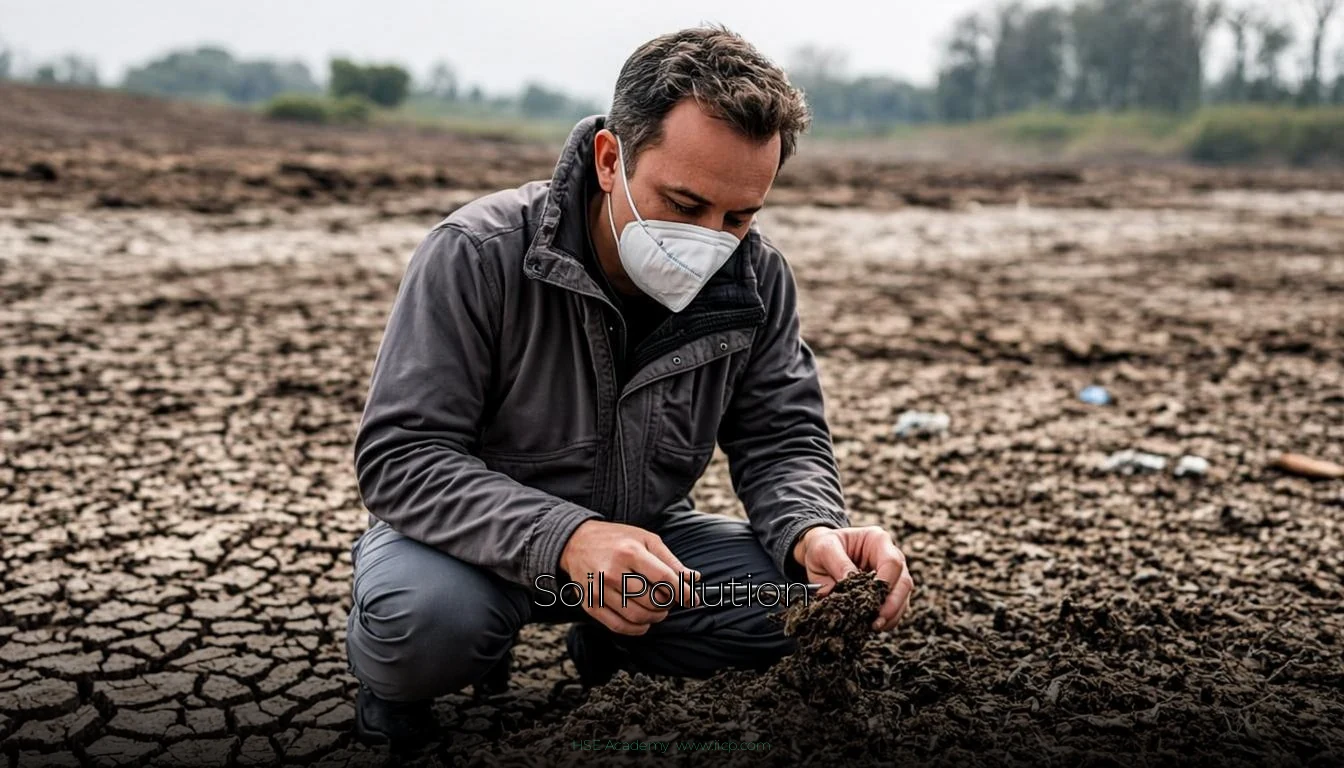
Soil Pollution in Industrial Environments: Prevention and Management of Contaminated Sites
Soil pollution from industrial activities (heavy metals, hydrocarbons, solvents) threatens groundwater and health. Prevention, diagnosis, and remediation of contaminated sites are essential in QHSE.
Industrial soil pollution constitutes a major environmental and public health issue in QHSE. Infiltrated pollutants threaten groundwater, biodiversity, and human health. The prevention, diagnosis, and remediation of polluted sites and soils (SSP) are regulated by legislation.
Common Pollutants
Heavy Metals
Lead, mercury, cadmium, chromium, arsenic — non-degradable, bioaccumulative, neurotoxic, and carcinogenic.
Hydrocarbons
- PAHs (Polycyclic Aromatic Hydrocarbons) — benzo[a]pyrene.
- BTEX (benzene, toluene, ethylbenzene, xylenes).
- CFCs and halogenated hydrocarbons.
Chlorinated Solvents
Trichloroethylene (TCE), tetrachloroethylene (PCE) — carcinogenic, highly persistent in soils, and rapid migrators towards aquifers.
Diagnosis
The process involves several steps:
- Historical study: analysis of archives (plans, BDDS, BASOL/BASIAS — French databases on polluted sites and soils).
- Field investigations: boreholes, piezometers, sampling.
- Laboratory analyses: chemistry, ecotoxicology.
- Detailed Risk Assessment (DRA) for current and future site uses.
Remediation
Depending on the nature and extent, several techniques are possible:
- Excavation + treatment: ex-situ decontamination (washing, biopiles, incineration).
- Bioremediation: microbial degradation of hydrocarbons.
- Containment: installation of impermeable barriers or surface treatment.
- In-situ treatment: venting, sparging, phytoremediation, thermal desorption, chemical oxidation.
Prevention
Prevention requires organizational and technical measures:
- Impermeent retention basins for liquid storage.
- Impermeent slabs in transfer areas.
- Pollution prevention plans and emergency procedures.
- PIG (Plan d'Intervention et de Gestion — French terminology; the Moroccan equivalent must be verified in implementing regulations) in case of a spill.
- Groundwater monitoring via piezometers.
Link to ISO 14001
The ISO 14001:2015 standard requires the control of significant environmental aspects, including the prevention of accidental and chronic pollution. The contaminated site is an environmental aspect to be assessed, controlled, and monitored.
Sources de pollution
Les principales sources industrielles sont :
-
Fuites de cuves et tuyauteries (hydrocarbures, produits chimiques).
-
Déversements accidentels lors de transvasement ou transport.