
Industrial Water: Treatment, Recycling and Sustainable QHSE
Workplace water management includes wastewater treatment, recycling and consumption reduction. A major QHSE issue linked to ISO 14001 and the water footprint.
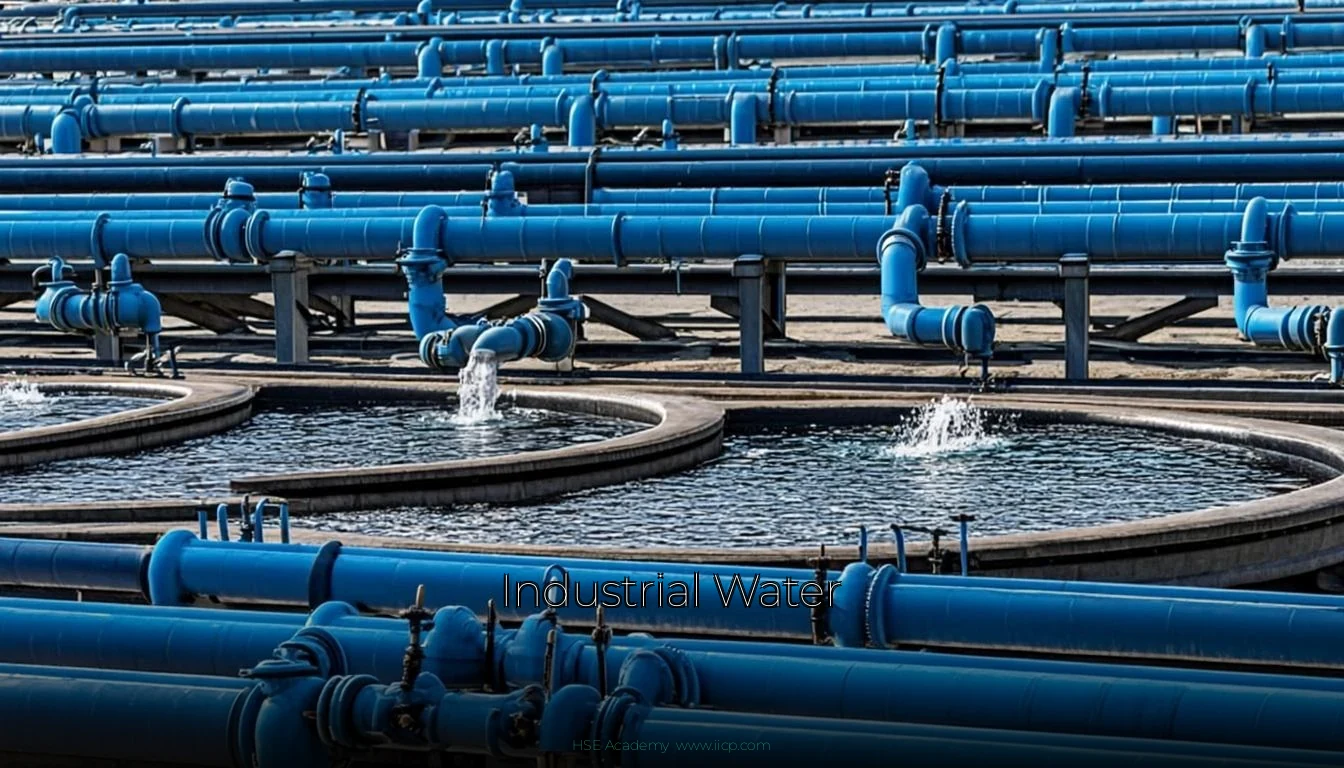
Industrial Water: Treatment, Recycling, and Sustainable Management in QHSE
Corporate water management encompasses wastewater treatment, recycling, and consumption reduction. A major QHSE challenge linked to ISO 14001 and the water footprint.
Corporate water management is a major QHSE challenge: resource scarcity, cost, regulatory constraints, and environmental impact. Wastewater treatment, recycling, and consumption reduction are the three pillars of sustainable management, linked to the ISO 14001:2015 standard and the concept of the water footprint.
Challenges
Industrial water represents a significant portion of global consumption (the order of magnitude varies by source and sector, typically around 15 to 20% according to international statistics, but this figure is not universal). The challenges for the company are multifaceted:
- Scarcity: Water stress in many regions (notably Morocco).
- Cost: Supply, treatment, fees, and taxes.
- Regulation: Permits for abstraction and discharge, quality standards.
- Image: Corporate social responsibility, stakeholder pressure.
Wastewater Treatment
Treatment generally follows three stages:
- Physical: Sedimentation, filtration, screening, separation of suspended matter, oils, and greases.
- Biological: Activated sludge, lagoons, membrane bioreactors (MBR) — degradation of organic matter by microorganisms.
- Chemical: pH neutralization, coagulation-flocculation, disinfection (chlorine, UV, ozone).
The regulatory discharge parameters include: COD, BOD5, TSS, N, P, hydrocarbons, heavy metals, pH, and temperature.
Recycling
Recycling enables the closure of the water cycle within the company:
- Greywater: Recycling of wash water for secondary cleaning.
- Closed loop: Closed cooling circuits, cooling towers.
- Process water: Recovery of rinse water, ultrafiltration, reverse osmosis.
The target recycling rate varies by industry (typically high for water-intensive industries, but there is no universal figure applicable to all situations — it depends on the process, required quality, and local constraints).
Consumption Reduction
Reducing consumption is achieved through:
- Meters: Sub-metering by workshop, consumption tracking, alerts.
- Leak detection: Water audits, mass balance.
- Water-efficient processes: Air cooling, high-pressure washing, retrofitting.
- Awareness: Operator training, anti-waste practices.
Link with ISO 14001
The ISO 14001:2015 standard identifies water as an environmental aspect to be managed. The Environmental Management System (EMS) requires the evaluation of aspects and impacts, the setting of objectives, and monitoring of discharges. The water footprint (ISO 14046:2014) complements the analysis.
Application in Morocco
Morocco, a country with water stress, imposes strict management through the Law No. 10-95 on Water (Dahir 1-95-154 of August 16, 1995). Industrialists must obtain abstraction permits and comply with discharge standards (Moroccan standards, NM). Priority sectors: agri-food, textiles, chemicals, mining.
Sources et références
-
Maroc — Loi n° 10-95 sur l'eau (Dahir 1-95-154 du 16/08/1995) Secrétariat général du gouvernement : https://www.sgg.gov.ma/Legislation.aspx
-
Code du travail marocain (Loi n° 65-99), Titre IV — articles 281 et suivants (principes généraux applicables) ILO NATLEX : https://natlex.ilo.org/dyn/natlex2/r/natlex/fe/details?p3_isn=67319
-
ISO 14001:2015 — Environmental management systems https://www.iso.org/standard/60857.html