Legionellosis in the Workplace: Prevention and Control
Legionellosis (Legionnaires' disease) is a lung infection transmitted by contaminated water aerosols. Cooling towers and hot water systems are the main sources of contamination in the workplace.
Legionnaires’ Disease in the Workplace: Prevention and Control
Legionnaires’ disease is an infection that can cause severe pneumonia. It is primarily transmitted by inhaling fine droplets of contaminated water. Cooling towers, hot-water systems and certain aerosol-generating installations can be sources of occupational exposure.
Legionnaires’ disease, also known as legionellosis in its broader medical context, is an infection caused by bacteria of the genus Legionella, particularly Legionella pneumophila. It can cause severe pneumonia and pose a health risk to workers exposed to aerosols containing contaminated water.
Prevention relies on appropriate installation design, regular maintenance, control of conditions that promote bacterial growth and risk-based monitoring.
1. Definition and Causative Agent
Bacteria of the genus Legionella occur naturally in aquatic environments, including lakes and rivers. They can also colonize artificial water systems.
Their growth is encouraged by certain conditions, including:
- Water temperatures generally between 20°C and 50°C, with particularly favorable growth conditions around 35°C.
- Stagnant water and areas with insufficient circulation.
- Biofilm formation on water-contact surfaces.
- Deposits and scale that may support bacterial growth.
- Inadequate maintenance or disinfection of installations.
The presence of Legionella in a water system does not automatically mean that someone will become infected. The risk depends on factors such as bacterial concentration, aerosol generation and dispersion, and the susceptibility of exposed individuals.
2. Sources of Contamination in the Workplace
Installations that may present a risk include:
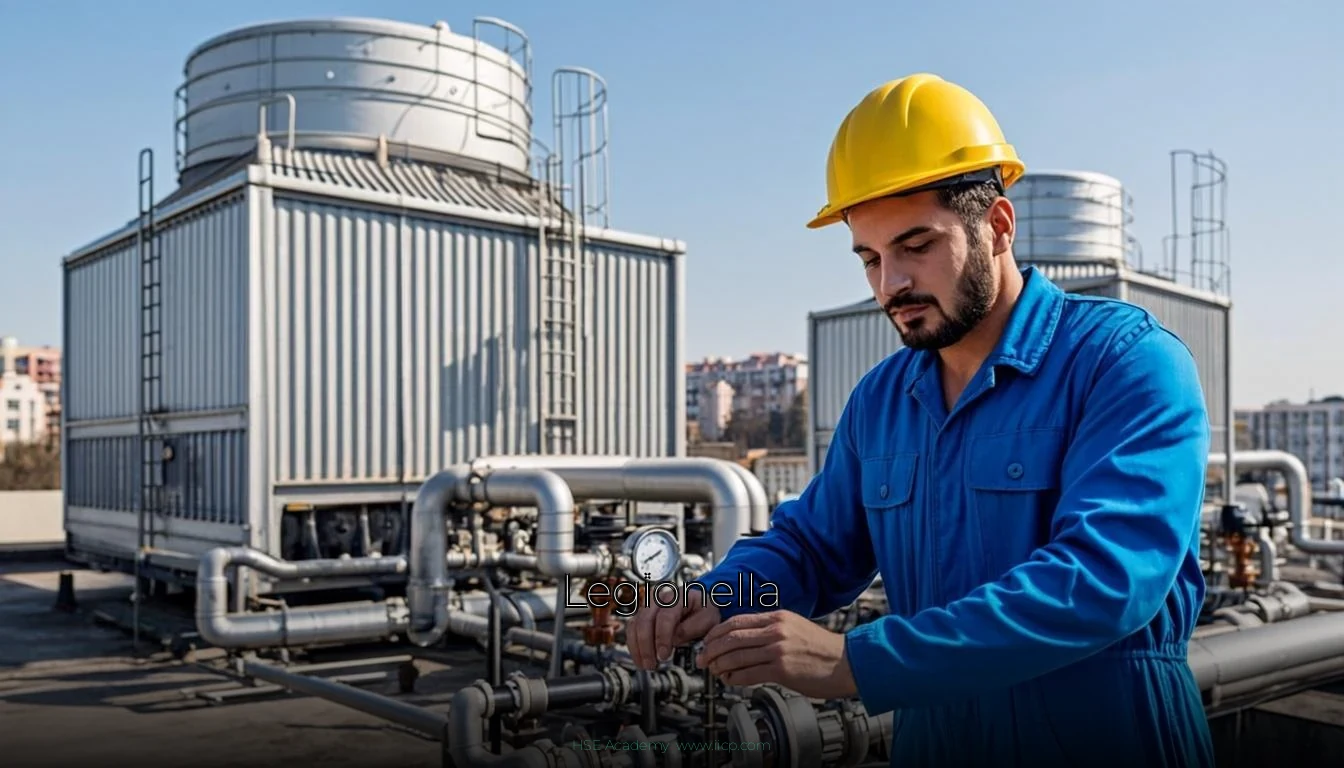
- Cooling towers: used in certain industrial cooling and air-conditioning systems, they can release aerosols into the surrounding air.
- Domestic hot-water systems: showers, taps and other outlets can generate droplets that may be inhaled.
- Hot tubs and certain hydrotherapy facilities: particularly when operating and maintenance conditions favor contamination.
- Humidifiers and certain water-using devices: when they generate contaminated aerosols.
- Certain technical installations and healthcare equipment: depending on their design, use and risk-control measures.
The level of risk varies according to the characteristics of each installation. An assessment should identify the relevant equipment, operating conditions and potential routes of aerosol dispersion.
3. Transmission Routes and Symptoms
Infection occurs primarily through the inhalation of aerosols containing Legionella. These aerosols may be generated by showers, cooling systems or other equipment using contaminated water.
Infection can also occur through aspiration of contaminated water into the respiratory tract, particularly in certain vulnerable individuals.
Direct person-to-person transmission is not considered a usual route of spread.
For Legionnaires’ disease, the incubation period is generally 2 to 10 days. Symptoms may include:
- High fever and chills.
- Cough, sometimes accompanied by breathing difficulties.
- Muscle pain and headaches.
- Significant fatigue.
- In some cases, digestive symptoms or confusion.
Legionnaires’ disease can progress to severe pneumonia. Anyone experiencing compatible symptoms after a possible exposure should seek medical attention promptly and explain the circumstances of the exposure.
4. Technical Prevention Measures
Prevention must be adapted to the type of installation and the risks identified. Its purpose is to limit Legionella growth and prevent the release of contaminated aerosols.
Temperature Control
Temperature management is an important measure in hot- and cold-water systems. Operating temperatures must be determined according to the system’s design, intended use, identified risks and applicable requirements.
Storage, distribution and point-of-use temperatures must not be treated as interchangeable. A temperature requirement should not be applied indiscriminately to every installation.
Measures involving changes to water temperature must also account for the risk of scalding and include appropriate safeguards.
Maintenance and Cleaning
Depending on the installation, maintenance activities should include:
- Cleaning equipment and relevant surfaces.
- Removing deposits and scale where necessary.
- Controlling biofilm formation.
- Checking water-treatment systems.
- Verifying that installations operate correctly.
- Managing prolonged shutdowns and recommissioning appropriately.
Cooling towers require particular attention because they can disperse aerosols into the surrounding environment.
Water Treatment and Disinfection
Different methods may be used depending on the installation, including certain thermal and chemical treatments. The choice depends on the risk assessment, material compatibility, water quality and applicable technical requirements.
Biocidal products must be used according to the manufacturer’s instructions and relevant safety requirements. Disinfection operations should be carried out by competent personnel using appropriate protective measures.
No single treatment method can guarantee the absence of risk if the system’s design, maintenance and operating conditions remain inadequate.
System Design
Appropriate system design helps reduce conditions that favor bacterial growth. Measures should include:
- Limiting dead legs and stagnant-water zones.
- Maintaining suitable water circulation.
- Providing access to equipment for cleaning and maintenance.
- Installing appropriate devices to limit droplet dispersion where necessary.
- Reducing risks associated with prolonged shutdowns and system restarts.
5. Monitoring and Microbiological Testing
Monitoring should be established according to the type of installation, its risk level, its use and the applicable regulatory requirements.
It may include:
- Monitoring operating parameters, particularly temperature.
- Checking cleaning and maintenance activities.
- Monitoring water-treatment processes.
- Conducting microbiological sampling and testing when justified by the risk assessment or applicable regulations.
- Recording interventions, results and corrective actions.
Microbiological culture can be used to detect viable Legionella. Molecular methods, such as PCR, can also provide useful information, but their results are not directly interchangeable with culture results. The appropriate method must be selected according to the purpose of the analysis and applicable requirements.
When results raise concerns, competent personnel should determine the necessary response. This may include verifying the result, investigating the installation, applying corrective treatment and, where necessary, restricting use or stopping aerosol-generating operations.
6. Regulatory Framework: France and Morocco
France
The Order of 14 December 2013, concerning classified installations using cooling systems that disperse water into an airflow, establishes specific requirements for certain installations covered by item 2921 of the French classified installations nomenclature.
Depending on the applicable regulatory regime, these requirements may address risk assessments, maintenance and monitoring plans, sampling, Legionella pneumophila testing and corrective measures when specified thresholds are exceeded.
This order applies to installations within its scope. It should not be presented as a general rule applicable to every building or water system.
Morocco
The Moroccan Labour Code (Law No. 65-99) provides a general framework for occupational health and safety. However, the specific obligations applicable to Legionnaires’ disease prevention must be determined by consulting current national legislation and considering the characteristics of the installation concerned.
Without a precise regulatory reference, it is not appropriate to claim that all Moroccan businesses must conduct periodic Legionella testing according to a uniform schedule, or that the National Office of Electricity and Drinking Water (ONEE) imposes this requirement on every workplace installation.
Facility managers should identify the requirements applicable to their sector and equipment by consulting the competent authorities and qualified professionals.
7. Practical Application in Moroccan Businesses
In hotels, healthcare facilities, industrial complexes and other buildings containing potentially high-risk installations, a documented risk-management approach can strengthen prevention.
Such an approach may include:
- Installation inventory: identify hot-water systems, cooling towers and equipment capable of generating aerosols.
- Risk assessment: identify stagnant-water zones, unfavorable temperature conditions, maintenance deficiencies and potential aerosol-dispersion routes.
- Maintenance program: define cleaning, inspection and maintenance activities appropriate to each installation.
- Monitoring: establish which operating parameters must be checked and determine whether microbiological testing is necessary.
- Anomaly management: define corrective measures for malfunctions or concerning test results.
- Staff training: inform personnel responsible for operation and maintenance about the risks, procedures and required protective measures.
- Recordkeeping: retain test results, maintenance records and decisions in accordance with applicable requirements.
This approach represents a prevention recommendation. Its specific content and legal status must be determined according to the regulations applicable to each facility.
Conclusion
Preventing Legionnaires’ disease in the workplace requires effective management of water systems, regular maintenance, control of conditions that promote bacterial growth and prevention of contaminated aerosol dispersion.
Temperature control, disinfection and testing must be adapted to each installation. French requirements do not automatically apply in Morocco, where legal obligations must be verified against current national legislation.
Sources and References
-
World Health Organization (WHO) — Legionellosis
https://www.who.int/news-room/fact-sheets/detail/legionellosis -
INRS — Legionellosis: Occupational Exposure and Prevention
https://www.inrs.fr/publications/bdd/eficatt/fiche.html?refINRS=EFICATT_L%C3%A9gionellose -
France — Order of 14 December 2013 concerning cooling installations covered by item 2921
https://www.legifrance.gouv.fr/loda/id/JORFTEXT000028375083