Medical Waste at Work: Sorting, Disposal and Safety
Healthcare waste (HCW) carries infectious, chemical and radioactive risks. Its sorting, storage and disposal are strictly regulated to protect workers and the environment.
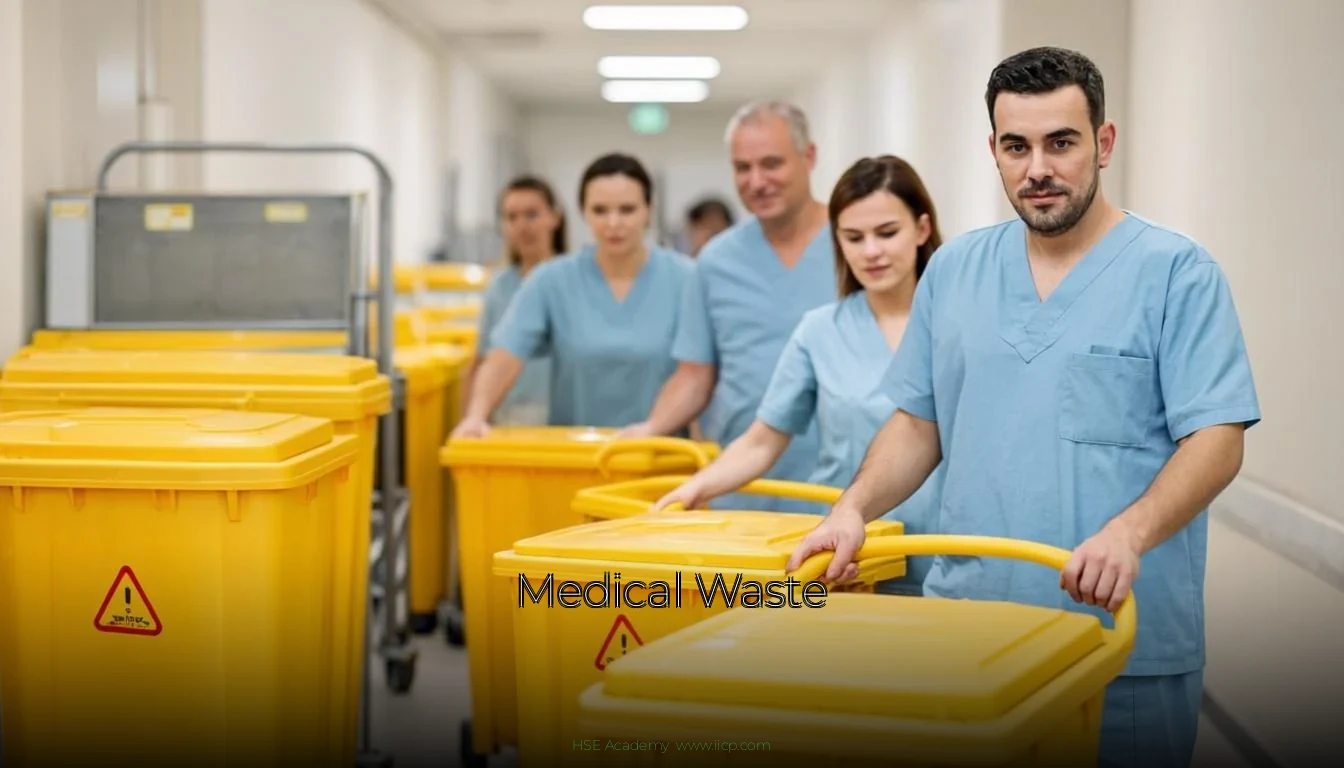
Medical Waste in the Workplace: Segregation, Disposal and Safety
Healthcare waste can pose infectious, chemical, toxic or radioactive hazards. Its segregation at source, packaging, storage, transportation and treatment must comply with applicable regulations to protect workers, the public and the environment.
Healthcare waste generated by hospitals, clinics, laboratories and medical practices requires management appropriate to its nature and level of risk. Improper handling can cause injuries, exposure to infectious agents or hazardous substances, and environmental contamination.
Waste management must be organised at every stage, from the point of generation to final treatment or disposal. Specific obligations depend on the waste category, the activity concerned and the applicable legislation.
1. Definition and Categories of Waste
Healthcare waste includes the following categories:
- Infectious waste: waste that may contain biological agents capable of causing infection, such as certain materials contaminated with blood or other bodily fluids.
- Sharps: needles, blades, scalpels and other objects that may cause injuries, whether contaminated or not.
- Chemical and pharmaceutical waste: expired or unused medicines, laboratory reagents, disinfectants and other substances presenting chemical or toxic hazards.
- Radioactive waste: waste containing or contaminated with radionuclides, generated by activities such as nuclear medicine or certain research procedures.
- Waste comparable to household waste: non-hazardous waste that may enter the ordinary waste stream when its classification permits this.
The precise classification must take into account the waste's origin, composition and characteristics, as well as applicable regulatory requirements. Not all waste generated in a healthcare facility is automatically hazardous.
2. Segregation at Source
Waste must be segregated at the point where it is generated. This separates different categories and ensures that each is directed to an appropriate management route.
Segregation must follow applicable legislation and the facility's internal procedures. Colour-coding systems may vary according to national regulations and the systems adopted by the establishment. No colour should be presented as universal without a verified applicable reference.
The main segregation principles are as follows:
- Infectious waste: use suitable, resistant and clearly labelled packaging that provides the necessary containment to prevent leakage and contamination.
- Waste comparable to household waste: keep it separate from hazardous waste only when its classification permits disposal through the ordinary waste stream.
- Sharps: place them immediately in rigid, puncture-resistant containers equipped with a secure closure system.
- Chemical and pharmaceutical waste: use containers compatible with the substances concerned, properly labelled and securely closed.
- Radioactive waste: manage it through a dedicated route in accordance with radiation protection requirements and applicable legislation.
Safety-engineered devices for needles and other sharps should be used where available and appropriate for the activity. Sharps must never be handled manually to sort them, retrieve them or remove them from a container.
Personnel responsible for waste collection must understand segregation procedures, the risks associated with each category and the actions required in the event of an incident.
3. Waste Storage
Storage arrangements must minimise the risk of leakage, spillage, contamination, staff exposure and access by unauthorised persons.
Measures should include:
- restricting access to authorised personnel;
- using suitable, closed and properly labelled containers;
- providing appropriate storage areas that are maintained and protected against pests;
- separating incompatible waste categories to prevent chemical reactions or cross-contamination;
- organising waste collection, transportation and traceability;
- complying with storage periods and conditions established by the applicable regulations for each category.
Storage periods and any temperature requirements must not be generalised. They must be verified against the legislation and requirements applicable to the type of waste and its storage conditions.
Damaged containers, leaks and spills must be managed under an appropriate safety procedure by trained and properly equipped personnel.
4. Treatment and Disposal
Treatment methods must be appropriate to the nature of the waste and comply with applicable health and environmental requirements. A method authorised for one waste category is not necessarily suitable for another.
Infectious Waste
Treatment routes may include:
- Incineration: in an authorised facility designed and operated for the waste concerned, with atmospheric emissions controlled in accordance with applicable requirements.
- Steam treatment or autoclaving: where the method is authorised and suitable for the waste category. After treatment, the waste must be directed to an authorised disposal route in accordance with applicable rules.
Incineration is not a universal requirement for all medical waste. Treatment temperatures and conditions depend on the technology, the facility and the applicable regulatory requirements. A temperature of 850°C should therefore not be presented as a general rule for every category of healthcare waste.
Non-Hazardous Waste Comparable to Household Waste
Waste classified as non-hazardous may be directed to authorised collection, recovery or disposal routes.
Recycling is appropriate only when the nature and condition of the waste, together with applicable regulations, permit it. Hazardous waste must never be mixed with ordinary waste to simplify disposal.
5. Special Waste Streams
Expired or Unused Medicines
Medicines must not automatically be discarded with ordinary waste or discharged into wastewater systems. They should be directed to an authorised collection and treatment route in the relevant country, according to their nature and the applicable rules.
The French Cyclamed system must not be presented as a collection route automatically available in Morocco.
Mercury-Containing Waste
Waste containing mercury, including certain dental amalgam waste, must be collected separately in suitable containers. This helps limit occupational exposure and mercury releases into the environment.
Radioactive Waste
Radioactive waste is subject to specific radiation protection and radioactive-material management requirements. Its handling must be organised with competent personnel and authorised facilities.
Storage for radioactive decay may be used only when authorised and appropriate for the radionuclides concerned. Before waste is released from the radioactive waste stream, it must undergo the checks and verification required by applicable regulations.
6. Regulatory Framework in Morocco
In Morocco, healthcare waste management is governed in particular by the following legislation:
- Law No. 28-00 on waste management and disposal, which establishes the general framework for waste management.
- Decree No. 2-09-139 of 21 May 2009 on the management of medical and pharmaceutical waste, which establishes specific provisions concerning its management, storage, treatment and disposal.
- Decree No. 2-14-85 of 20 January 2015 on hazardous waste management, applicable to waste falling within its scope.
Internal waste management must be organised according to the waste category and the obligations applicable to the facility. When waste management is entrusted to a contractor, the relevant contractual arrangements and regulatory requirements must be respected.
Collection, transportation, storage, treatment and disposal may be subject to specific requirements, including authorisation and traceability obligations. The applicable requirements must therefore be verified for each waste category rather than assuming that every waste stream is subject to identical rules.
Radioactive waste must be managed in accordance with the specific regulations applicable to it, in addition to any relevant general provisions.
7. Responsibilities and Risk Prevention
Effective healthcare waste management requires clear organisation and appropriate training.
Preventive measures include:
- training workers in waste segregation, packaging and safe handling;
- providing protective equipment appropriate to the tasks and risks;
- preventing sharps containers from becoming overfilled;
- cleaning and maintaining storage areas;
- organising waste collection and traceability;
- establishing procedures for needlestick injuries, cuts, leaks and spills;
- verifying that contractors and treatment facilities hold the required authorisations, where applicable.
Training should be renewed according to the risks, changes in procedures, incidents identified and applicable requirements.
Conclusion
Healthcare waste management is an essential part of occupational risk prevention and environmental protection. Segregation at source, appropriate packaging, secure storage and the use of authorised treatment routes help reduce risks to workers, patients and the public.
In Morocco, waste management procedures must comply with the legislation governing medical and pharmaceutical waste, together with the applicable provisions on hazardous and radioactive waste. Procedures must be adapted to each waste category without generalising colour codes, storage periods or treatment methods.
Sources and References
- World Health Organization (WHO) — Health-care waste: https://www.who.int/news-room/fact-sheets/detail/health-care-waste
- Moroccan Ministry of Health and Social Protection — Regulatory texts on the management and disposal of waste: https://www.sante.gov.ma/Reglementation/Pages/GESTION-ET-ELIMINATION-DES-DECHETS.aspx?ID=24
- Moroccan Ministry of Energy Transition and Sustainable Development — Regulatory framework for hazardous waste: https://www.environnement.gov.ma/fr/component/content/article?id=947%3Apublication-du-decret-relatif-a-la-gestion-des-dechets-dangereux-au-bulletin-officiel