
QHSE Documentation: Document and Procedure Control
Document control is a key element of QHSE management systems per ISO 9001, 14001 and 45001. This article presents documentary management requirements, document types and best practices.
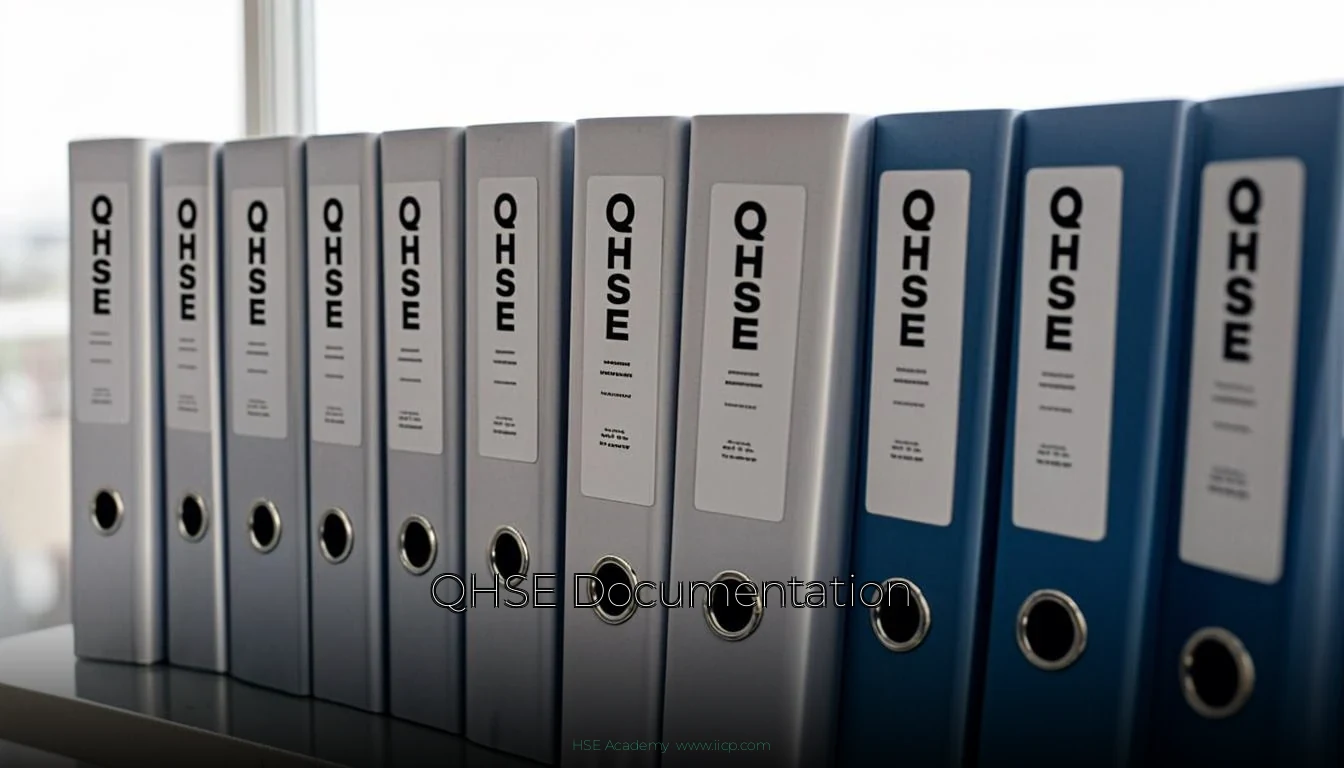
QHSE Documentation: Mastering Documents and Procedures
Document control is a key element of QHSE management systems according to ISO 9001, 14001, and 45001. This article presents the documentation management requirements, document types, and best practices.
Document control is a cornerstone of QHSE systems. Without controlled documentation, traceability and auditing are impossible. The ISO 9001:2015 (quality), ISO 14001:2015 (environment), and ISO 45001:2018 (OHS) standards share a common requirement: to control documents and records.
Types of QHSE Documents
A document pyramid structures QHSE systems:
- QHSE Policy — Formal management commitment, strategic direction.
- QHSE Manual — Description of the system scope, process mapping.
- Procedures — Formalized description of "who does what, when, and how" (procurement procedure, non-conformity management procedure, internal audit procedure).
- Instructions / Work Instructions — Detailed description of a task (job instruction, checklist).
- Records — Objective evidence (completed forms, audit reports, calibration certificates, maintenance logs).
Document vs. Record
The distinction is fundamental in QHSE:
- A document is controlled information (procedure, policy) that must be followed. Its distribution and version are controlled.
- A record is a fixed proof of an activity performed (incident report, noise measurement) that must not be modified. Its archiving and retention period are controlled.
ISO Standard Requirements
The "Documented Information" clause (clause 7.5) of the modern ISO standards (ISO 9001:2015, ISO 14001:2015, ISO 45001:2018) requires the organization to:
- Approve documents prior to publication (validation, signature).
- Distribute the relevant version to relevant users (and withdraw obsolete versions).
- Review and update at defined intervals or upon changes.
- Archive historical versions with defined retention periods.
- Identify the version (number, date, revision status).
- Protect externally provided documents and records.
Electronic Document Management (EDM)
A QHSE EDM platform (dedicated software, intranet, Microsoft SharePoint, M-Files) automates: approval workflows, distribution control, review alerts, archiving, and consultation traceability. It secures access in the event of an external audit.
Best Practices
- Readable and standardized format (header, footer, numbering, revision status).
- Indexing by keyword, process, and document type.
- Periodic review at least annually.
- Access control: read, modify, and approval according to user profiles.
Application in Morocco
Moroccan companies certified to ISO 9001:2015 / ISO 14001:2015 / ISO 45001:2018 apply this control in compliance with local requirements (language, regulations). Bilingual versions (French/Arabic) are common.
Sources et références
-
Code du travail marocain (Loi n° 65-99), Titre IV — articles 281 et suivants (principes généraux de prévention, traçabilité) ILO NATLEX : https://natlex.ilo.org/dyn/natlex2/r/natlex/fe/details?p3_isn=67319
-
INRS — Outils d'aide à l'évaluation des risques (portail risques) https://www.inrs.fr/risques.html
-
ISO 9001:2015 — Quality management systems (chapitre 7.5 Information documentée) https://www.iso.org/standard/62085.html