
Guardrails and Lifelines: Collective Fall Protection
Collective fall protection (guardrails, lifelines, nets) must always take priority over personal protection (harnesses). This article covers standards, installation and employer obligations.
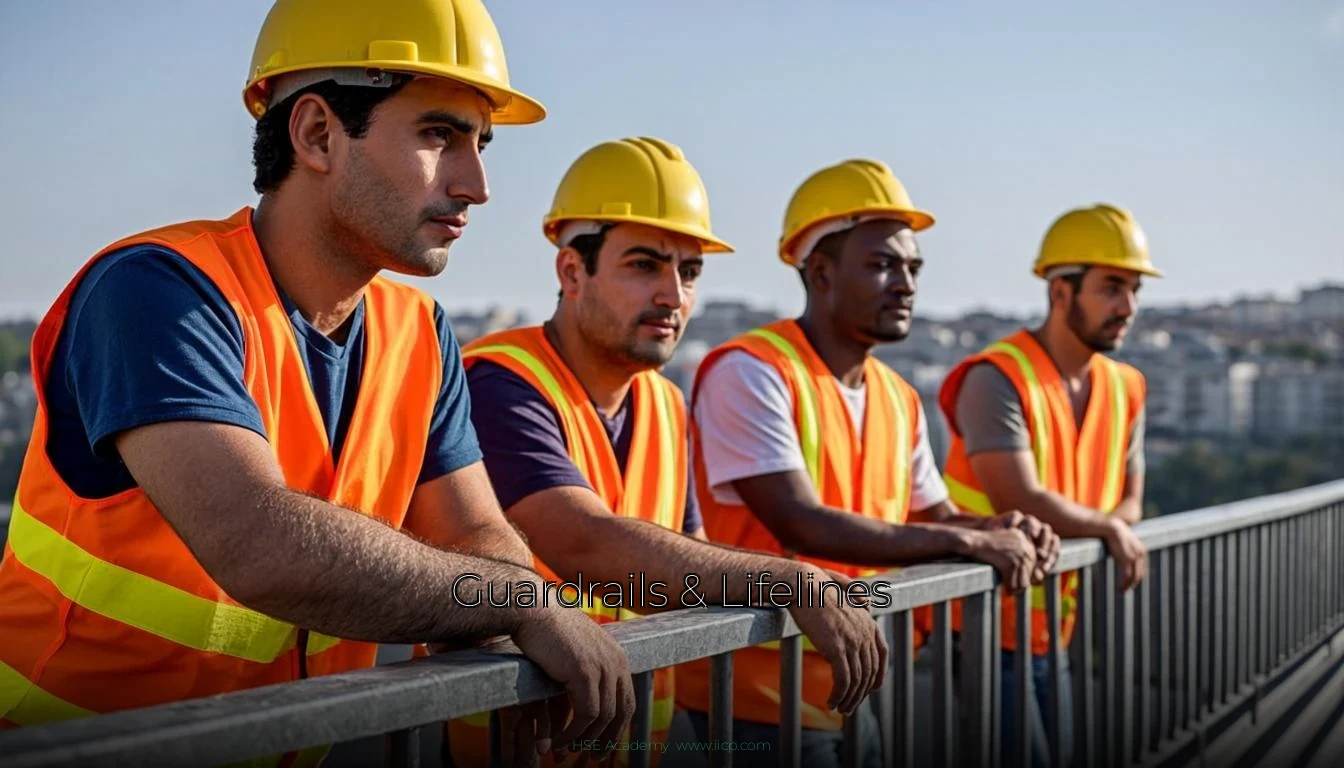
Guardrails, Safety Nets and Lifelines: Preventing Falls from Height
Introduction
Falls from height are a major occupational risk in construction, industrial maintenance, warehousing and many other professional activities. They can cause serious injuries or fatalities, even when the fall occurs from a relatively low level.
Preventing these accidents requires a risk assessment, appropriate collective protective measures, suitable personal protective equipment (PPE) where necessary, and regular inspection of safety systems.
The priority is collective protection, such as guardrails and safety nets. Lifelines and other personal fall-protection systems are used when collective protection cannot be implemented or does not adequately control the risk.
1. Guardrails: collective protection against falls
Guardrails provide a physical barrier that prevents workers from falling from exposed edges, platforms, roofs, walkways and other elevated work areas.
A compliant guardrail system generally includes:
- A main handrail: designed to prevent a person from falling over the edge.
- An intermediate rail: prevents a person from passing through the space beneath the main handrail.
- A toe board: helps prevent tools, materials and other objects from falling onto people below.
The dimensions, strength and configuration of guardrails must be appropriate for the workplace, the foreseeable risks and the applicable requirements.
Installation and inspection
Before work begins, verify that guardrails are securely installed and that their components are in good condition. Pay particular attention to connections, anchorage points, gaps, damaged parts and any sections removed temporarily to allow access.
Guardrails must not be removed or modified without appropriate precautions. If a section must be opened, an alternative protective measure must be implemented before the opening creates a fall hazard.
Important: European standards, such as EN 13374, provide technical specifications for temporary edge-protection systems. Their applicability and legal status must be assessed in the relevant country and work context.
2. Safety nets: collective protection beneath work areas
Safety nets are designed to catch a person who falls or, depending on the system, to retain falling objects. They can be used on construction sites, during certain roof works and in other situations where an appropriate installation is possible.
Unlike guardrails, safety nets do not necessarily prevent a fall from starting. Their purpose is to limit the consequences of a fall by arresting the person within the net.
Essential safety requirements
Before installing a safety net, the responsible personnel should verify that:
- The net is suitable for the intended application and complies with the relevant technical requirements.
- The supporting structure and anchorage points can withstand the loads generated during a fall.
- The net is installed according to the manufacturer's instructions and the approved installation method.
- Sufficient clearance is available beneath the net to prevent the falling person from striking the ground, equipment or other obstacles.
- The net is positioned as close as reasonably practicable to the working area, while respecting the system's design limitations.
- Access for rescue and the recovery of a person caught in the net has been considered.
Safety nets must be inspected before use and at the intervals specified by the manufacturer and applicable requirements. Any damaged, modified or suspect net must be taken out of service until its suitability has been established.
Technical reference: EN 1263 addresses safety nets and their associated requirements. The applicable version and national adoption should be checked before specifying a system.
3. Lifelines: personal fall-protection systems
A lifeline is generally an anchorage system used with compatible personal fall-protection equipment. Depending on its design, it may allow a worker to move while remaining connected to the system.
A lifeline is not, by itself, collective protection. It forms part of a personal fall-protection system and requires suitable equipment, correct use and appropriate training.
There are several common configurations:
- Horizontal lifeline: allows movement along a horizontal route while the worker remains connected.
- Vertical lifeline: supports movement along a vertical route, such as a ladder or access structure.
- Rigid anchorage rail: provides a guided connection along a defined route.
Lifelines may be permanent or temporary. Their design and installation must take account of the structure, the number of users, the direction of loading, the possibility of a fall and the rescue arrangements.
Fall restraint and fall arrest
Two concepts must be distinguished:
- Fall restraint: the system prevents the worker from reaching a position where a fall could occur.
- Fall arrest: the system allows a fall to begin but arrests it before the worker strikes a lower level.
Where practicable, fall restraint is preferable because it prevents the fall from occurring. Fall-arrest systems require a suitable harness, compatible connectors, an appropriate anchorage and a clear space beneath the worker.
The available clearance, known as the fall-arrest clearance or fall clearance, must be calculated for the specific system. It depends on factors such as lanyard or device deployment, the worker's position, the harness attachment point and the distance required to avoid striking obstacles. A pendulum effect must also be considered where the worker could swing sideways during a fall.
Anchorage points and technical standards
EN 795 covers requirements for certain types of anchorage devices used in personal fall-protection systems. It distinguishes, among other configurations:
- Type A: fixed anchorage devices requiring structural anchors.
- Type B: temporary anchorage devices.
- Type C: flexible horizontal lifeline systems.
- Type D: rigid horizontal anchorage-line systems.
- Type E: deadweight anchorage devices.
The suitability of a device depends on its design, installation, intended use and compatibility with the complete fall-protection system. There is no single anchorage-strength value that is appropriate for every configuration. Loads and performance requirements must be assessed according to the relevant standard, the manufacturer's specifications and the applicable rules.
4. Choosing the right protection
The choice of protective system must follow a risk assessment that considers the work activity, the height and geometry of the exposed area, the duration of the task, access requirements, environmental conditions and the possibility of rescuing a worker after a fall.
The general prevention hierarchy is:
- Avoid work at height whenever reasonably practicable.
- Prevent falls using collective protection, such as guardrails or suitable safety nets.
- Where collective protection is not feasible or sufficient, use an appropriate personal system, such as fall restraint or fall arrest.
- Provide training, supervision, inspections and emergency arrangements to support the selected measures.
No single system is suitable for every situation. For example, a guardrail may be the preferred solution for a permanently accessible platform, while a properly designed lifeline may be necessary for certain roof-maintenance activities.
5. Legal and regulatory considerations in Morocco
In Morocco, employers must assess occupational risks and implement appropriate measures to protect workers' health and safety in accordance with the applicable national legislation, including the Labour Code (Law No. 65-99) and any relevant sector-specific requirements.
European standards such as EN 13374, EN 1263 and EN 795 can provide useful technical references when selecting protective equipment. However, a European standard should not automatically be presented as a Moroccan legal obligation. Its applicability must be established in the context of the relevant regulations, contracts and technical specifications.
Before beginning work, the employer or responsible site manager should ensure that:
- The risks of falling and falling objects have been assessed.
- Suitable collective or personal protection has been selected.
- Equipment has been installed, used and inspected according to its specifications.
- Workers have received appropriate instructions and training.
- A practical rescue procedure is available wherever a worker could be suspended following a fall.
The exact obligations may vary according to the activity, workplace and applicable regulatory provisions.
6. Common mistakes to avoid
The following practices can undermine fall-prevention measures:
- Relying on a personal harness when effective collective protection could reasonably be installed.
- Using a lifeline without verifying its compatibility with the harness, connectors and anchorage.
- Assuming that an anchorage is suitable simply because it appears strong.
- Failing to calculate the clearance required by a fall-arrest system.
- Installing a safety net without checking the clearance beneath it.
- Using damaged equipment or equipment whose inspection status is unknown.
- Removing guardrails without implementing an alternative protective measure.
- Having no rescue plan for a worker suspended after a fall.
Conclusion
Guardrails and safety nets are important collective measures for preventing or limiting falls from height. Lifelines and other personal fall-protection systems provide additional solutions when properly selected, installed and used.
Effective prevention depends on the hierarchy of controls, a site-specific risk assessment, compatible equipment, regular inspections and suitable rescue arrangements. Technical standards can support these decisions, but their legal status must be distinguished from the requirements applicable in Morocco.
References
- INRS – Prevention of falls from height: https://www.inrs.fr/risques/chutes-hauteur/prevention-chutes-hauteur
- INRS – Regulations relating to work at height: https://www.inrs.fr/risques/chutes-hauteur/reglementation-travail-hauteur.html
- International Labour Organization, NATLEX – Moroccan Labour Code: https://natlex.ilo.org/dyn/natlex2/r/natlex/fe/details?p3_isn=67319