Hazardous Product Storage: SEVESO Directive and Prevention
The SEVESO directive governs storage of hazardous substances in large quantities. SEVESO facilities must implement a Safety Management System (SMS) and an Internal Emergency Plan (IEP).
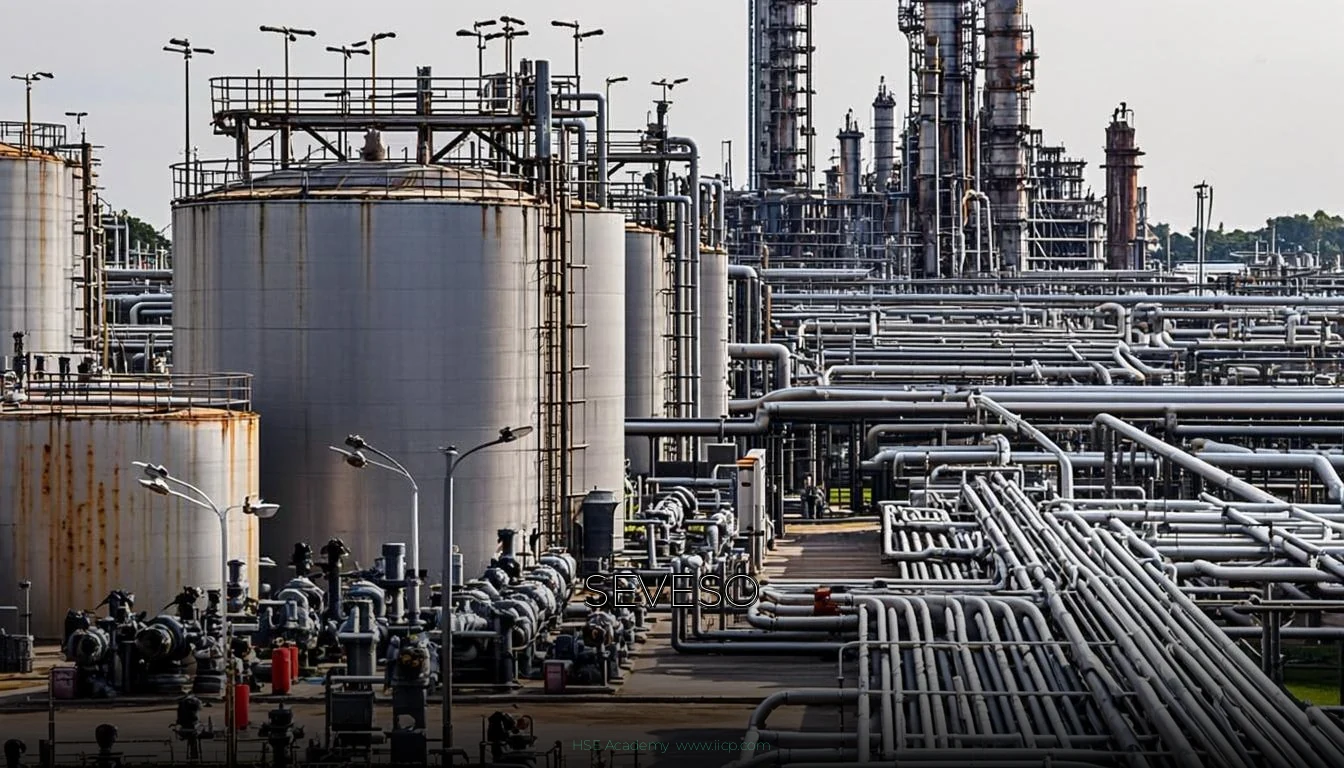
Storage of Hazardous Substances: The SEVESO Directive and Accident Prevention
Storing large quantities of hazardous substances can create risks of fire, explosion, or toxic release. In the European Union, the SEVESO III Directive establishes a framework for preventing major accidents at certain establishments, depending on the substances present and the quantities involved. In Morocco, applicable obligations must be determined by reference to the relevant national legislation.
The storage of hazardous substances in industrial facilities requires careful organization based on the physicochemical properties of the substances, the quantities stored, and the risks posed to workers, nearby communities, and the environment.
In the European Union, the SEVESO III Directive (2012/18/EU) aims to prevent major accidents involving dangerous substances and limit their consequences for human health and the environment. It does not automatically apply to every warehouse containing hazardous products. Its scope depends on the substances present, their quantities, and the classification rules established by the Directive.
1. Origin and Development of the SEVESO Directive
The SEVESO Directive takes its name from the industrial accident that occurred on 10 July 1976 in Meda, near Seveso, Italy, at a chemical plant operated by ICMESA. The accident released toxic substances, including TCDD dioxin, and contributed to the development of a specific European regulatory framework for preventing major industrial accidents.
Three generations of directives have followed:
- SEVESO I — Directive 82/501/EEC: Adopted in 1982, it established the first specific European framework for preventing major accidents associated with certain industrial activities.
- SEVESO II — Directive 96/82/EC: Adopted in 1996, it strengthened requirements for accident prevention, risk control, and emergency preparedness.
- SEVESO III — Directive 2012/18/EU: Adopted on 4 July 2012 and applicable from 1 June 2015, it adapted the classification of dangerous substances to the European CLP Regulation on classification, labelling, and packaging.
2. Definition and Scope of Application
The SEVESO III Directive applies to establishments where dangerous substances are present, or may be present, in quantities reaching the thresholds specified in Annex I.
Classification depends on several factors:
- The identity and regulatory classification of the substances.
- The maximum quantities that may be present.
- The applicable thresholds for each hazard category.
- The aggregation rules established by the Directive.
- Any exclusions or specific provisions set out in the legislation.
The hazards covered may relate to human health, the physical and chemical properties of substances, and their effects on the environment.
Simply having a product described as “hazardous” is therefore insufficient to determine whether an establishment falls under SEVESO. Annex I and the applicable calculation rules must be examined.
3. Classification: Lower-Tier and Upper-Tier Establishments
The Directive distinguishes between two categories of establishments according to the quantities of dangerous substances present and the applicable regulatory thresholds.
Lower-tier establishments
Operators of lower-tier establishments must comply with requirements that include notification and the preparation of a Major Accident Prevention Policy (MAPP). This policy defines the operator’s safety objectives, prevention principles, and management commitment.
The precise obligations depend on the Directive and its implementation in the national law of the relevant EU Member State.
Upper-tier establishments
These establishments are subject to more extensive requirements, including:
- A Major Accident Prevention Policy.
- A safety management system appropriate to the risks.
- A safety report.
- An internal emergency plan.
- The provision of information required by the competent authorities to prepare the external emergency plan.
The competent authorities organize the preparation of the external emergency plan in accordance with the applicable regulatory provisions.
Important: SEVESO classification does not, by itself, mean that every facility must obtain a specific prior authorization under the Directive. Other authorization, notification, or inspection requirements may also apply, depending on the activity, site, and national legislation.
4. Safety Management System (SMS)
The safety management system aims to prevent major accidents and limit their consequences. For establishments subject to the relevant SEVESO III requirements, it must be appropriate to the nature of the hazards and the complexity of the activities.
Its main elements include:
- Major Accident Prevention Policy: Establishing safety objectives, commitments, and prevention principles.
- Organization and responsibilities: Defining roles, responsibilities, and the competencies required to control risks.
- Hazard identification and assessment: Analyzing substances, processes, installations, and accident scenarios.
- Operational control: Establishing procedures for work, storage, handling, maintenance, and inspections.
- Management of change: Assessing technical or organizational changes that could affect safety.
- Training and awareness: Developing the competence of employees and relevant contractors.
- Emergency preparedness: Organizing alerts, response arrangements, and exercises.
- Monitoring and improvement: Analyzing incidents and near misses, implementing corrective actions, and reviewing prevention measures.
The system must be consistent with the applicable regulatory obligations and the identified major accident risks.
5. Internal Emergency Plan (IEP)
The Internal Emergency Plan (IEP) defines the organization and actions required within an establishment in the event of a major accident or a situation that could lead to one.
Under SEVESO III, the operator of an upper-tier establishment must prepare this plan in accordance with the applicable requirements. The competent authorities prepare the external emergency plan when the conditions specified in the Directive are met.
The IEP should specify:
- The personnel authorized to activate emergency procedures.
- Responsibilities and coordination arrangements.
- Procedures for alerting employees and emergency services.
- Available emergency response equipment and resources.
- Evacuation or shelter-in-place instructions, depending on the scenario.
- Measures to limit consequences for people and the environment.
- Communication arrangements with authorities and emergency services.
- Exercises, verification procedures, and plan updates.
Procedures must reflect the actual hazards present at the site. A fire, an explosion, and a toxic release may require different response measures.
6. Hazard Assessment and Safety Report
Hazard assessment aims to identify events that could cause a major accident and evaluate their potential consequences.
For upper-tier establishments, the safety report required under SEVESO III describes the dangerous substances, installations, major accident scenarios, prevention measures, and arrangements for limiting consequences.
The assessment may examine scenarios such as:
- Loss of containment involving a hazardous liquid or gas.
- A fire involving stored flammable substances.
- An explosion involving an explosive atmosphere.
- The release and dispersion of a toxic cloud.
- A dangerous reaction caused by incompatible substances.
- The escalation of an accident to other installations or storage areas.
For each scenario, the assessment should consider possible causes, consequences, preventive barriers, protective measures, and emergency arrangements.
Assessment methods and risk acceptance criteria must be selected according to the applicable regulatory framework and the characteristics of the site.
The ALARP principle (As Low As Reasonably Practicable) refers, in certain risk management frameworks, to reducing risk to a level that is as low as reasonably practicable. It should not be presented as a universally mandatory legal formulation imposed by SEVESO III.
7. Good Practices for Hazardous Substance Storage
Regardless of SEVESO classification, storage arrangements must reflect the hazards associated with the products and the legal requirements applicable to the facility.
Technical and organizational measures to consider include:
- Product identification: Keep regulatory labels and up-to-date safety data sheets available and accessible.
- Segregation of incompatible substances: Prevent contact or mixing that could cause fires, dangerous reactions, or toxic releases.
- Control of ignition sources: Adapt equipment and procedures to the risks of fire and explosion.
- Ventilation: Ensure that ventilation arrangements are appropriate for the properties of the stored substances.
- Spill containment: Provide suitable systems to limit the spread of leaks and protect soil and water.
- Access and circulation: Keep traffic routes and emergency access points clear.
- Protection against impact: Protect containers, tanks, and equipment from mechanical damage.
- Quantity control: Monitor stock levels and account for the maximum quantities relevant to risk assessment and, where applicable, regulatory classification.
- Training: Inform employees about hazards, handling rules, protective equipment, and emergency procedures.
- Incident management: Report leaks, equipment failures, unexpected reactions, and near misses to help prevent recurrence.
These measures must be adapted to the substances involved. They do not replace a risk assessment or verification of the applicable regulatory requirements.
8. Application in Morocco: Regulatory Framework to Verify
Morocco is not directly subject to the European SEVESO III Directive. An establishment located in Morocco does not automatically become legally classified as a SEVESO establishment simply because it stores large quantities of hazardous substances.
It must comply with Moroccan legislation applicable to its activities, installations, stored substances, and associated risks.
Relevant legal references to examine include:
- The Dahir of 25 August 1914 concerning establishments classified as unhealthy, inconvenient, or dangerous, together with subsequent amendments, supplementary legislation, and provisions governing the classification of establishments.
- Law No. 12-03 on Environmental Impact Assessments, whose applicability must be assessed in light of the project and the legislation in force.
- Law No. 11-03 on the protection and enhancement of the environment, where relevant to the environmental issues involved.
Law No. 17-97 concerns industrial property. It is not the principal legal reference for the classification of dangerous establishments.
For each facility, it is essential to verify the applicable legislation, required authorizations, storage conditions, and any obligations relating to risk studies, emergency plans, and coordination with emergency services.
Major accident prevention principles—including hazard identification, risk control, training, response organization, and emergency preparedness—provide useful technical guidance in Morocco. However, specific requirements under SEVESO III must not be presented as Moroccan legal obligations unless they are supported by verified national legislation.
Conclusion
The storage of hazardous substances requires rigorous control of fire, explosion, chemical reaction, and toxic release risks.
In the European Union, the SEVESO III Directive establishes enhanced obligations for establishments that reach specified thresholds of dangerous substances, particularly regarding major accident prevention, safety management, safety reports, and emergency preparedness.
In Morocco, the process must begin by identifying the national legislation applicable to the activity and site. European frameworks can help improve prevention practices, but they must not be confused with Moroccan regulatory requirements.
Sources and References
-
Directive 2012/18/EU — SEVESO III, EUR-Lex:
https://eur-lex.europa.eu/eli/dir/2012/18/oj/fra -
Moroccan Ministry of Health — Dahir of 25 August 1914 concerning establishments classified as unhealthy, inconvenient, or dangerous:
https://www.sante.gov.ma/Reglementation/ProtectionSante/Documents/Dahir%20du%2025%20ao%C3%BBt%201914.pdf -
INRS — Explosion risks and reference legislation:
https://www.inrs.fr/risques/explosion/reglementation-textes-reference.html