
Machine Safety: Prevention, Guards and Lockout (LOTO)
Machine safety relies on intrinsic prevention, guards, and lockout (LOTO — Lockout/Tagout). This article presents principles and machine safety standards.
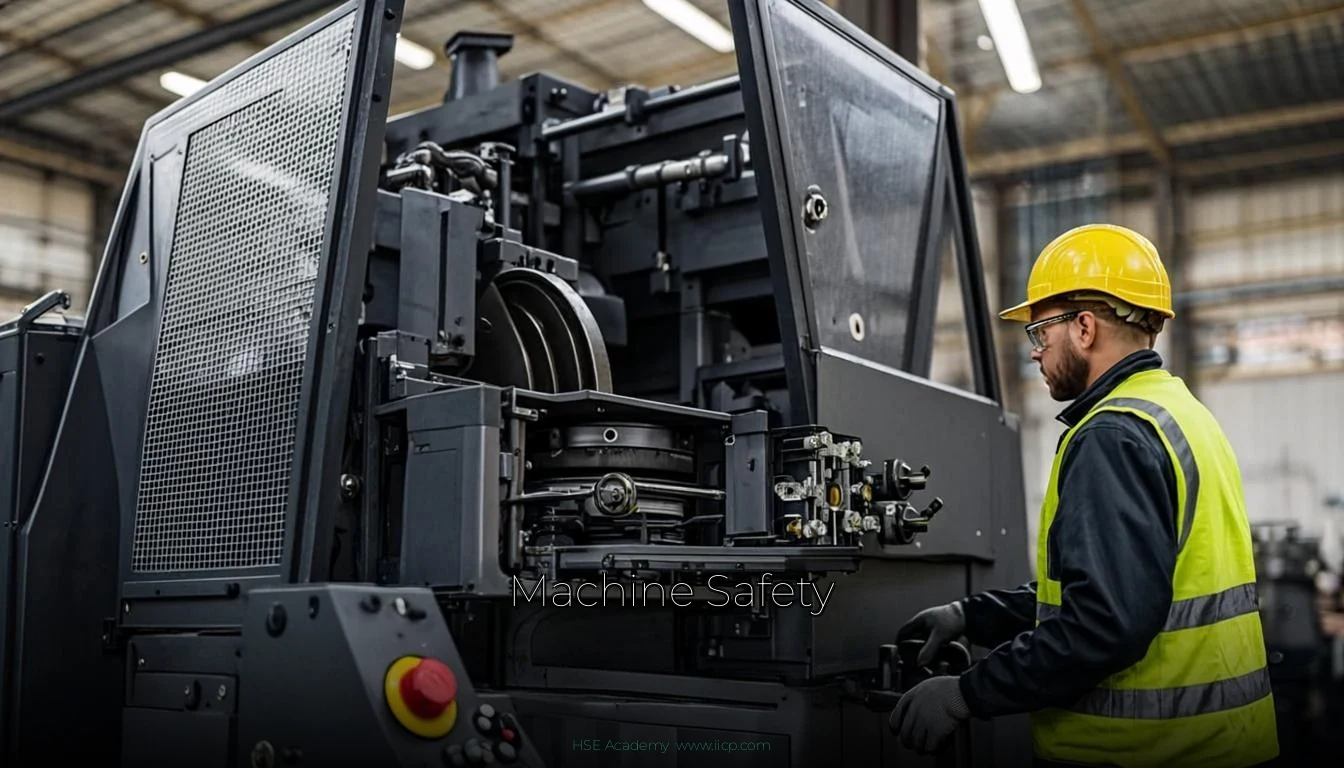
Machine Safety: Prevention, Machine Guards and Lockout/Tagout (LOTO)
Machine safety relies on eliminating hazards at the design stage, installing appropriate guards and safety devices, and controlling hazardous energy during maintenance operations. The LOTO method (Lockout/Tagout) helps prevent unexpected machine start-up and the dangerous release of stored energy.
Machine safety is a fundamental component of occupational risk prevention. According to the French National Research and Safety Institute (INRS), machinery accounts for approximately 10–15% of workplace accidents resulting in at least four days of absence in France, based on 2016 data from the French National Health Insurance Fund (CNAM). This statistic relates to the French context and must not be directly extrapolated to Morocco.
Maintenance, cleaning, adjustment and jam-clearing operations require particular attention. Effective prevention involves a structured approach: assessing risks, eliminating hazards wherever possible, protecting workers against residual risks, and controlling hazardous energy before any intervention.
1. Fundamental Principles of Machine Risk Prevention
The prevention approach described in ISO 12100 includes three main steps.
1.1. Inherently Safe Design
Inherently safe design involves eliminating hazards or reducing risks at the machine design stage.
Measures may include:
- Eliminating or reducing crushing, shearing and trapping points.
- Limiting forces, speeds or hazardous energy where technically feasible.
- Selecting technical solutions that present fewer risks.
- Designing appropriate control systems and operating modes.
- Reducing the need for workers to enter hazardous areas.
This approach takes priority because it addresses hazards at their source.
1.2. Machine Guards and Complementary Protective Measures
When hazards cannot be completely eliminated through design, suitable guards and protective devices must be installed.
Machine guards should be distinguished from guardrails used to prevent falls from height. Machine guards prevent or restrict access to dangerous machine components.
The main types include:
- Fixed guards: covers, casings and enclosures that generally require a tool to remove.
- Movable guards: doors or covers that can be opened to access a working area.
- Interlocking movable guards: devices that prevent certain hazardous functions from operating when the guard is open or initiate the required stop function.
- Guard locking: systems that keep a guard closed until the hazards associated with dangerous machine functions have sufficiently diminished.
- Non-contact protective devices: for example, light curtains that detect a person entering a hazardous area.
- Pressure-sensitive mats and two-hand controls: solutions suitable for specific applications and operating conditions.
ISO 14120 and ISO 14119 are important technical references for guard design and interlocking devices. The appropriate solution must account for the machine, the identified risks, operating conditions and frequency of access.
1.3. Information, Training and Work Organisation
Technical measures must be supplemented by suitable procedures and worker training.
These measures include:
- Safe operating instructions.
- Identification of hazardous areas.
- Cleaning and maintenance procedures.
- Training for operators and technical personnel.
- Signage identifying residual risks.
- Regular inspection of guards and safety devices.
Personal protective equipment (PPE) may complement these measures but does not replace the necessary technical safeguards.
2. The LOTO Method: Lockout/Tagout and Hazardous Energy Control
LOTO (Lockout/Tagout) refers to procedures used to isolate energy sources, secure isolation devices and prevent hazardous re-energisation or unexpected machine start-up during an intervention.
It addresses risks associated with electrical, pneumatic, hydraulic, mechanical, thermal and gravitational energy, as well as stored energy.
LOTO is a recognised industrial safety practice. In the United States, OSHA regulation 29 CFR 1910.147 governs hazardous energy control for activities within its scope. In Morocco, the measures to be implemented must be determined by reference to relevant national legislation, the risk assessment and procedures appropriate to the installation.
2.1. Essential Lockout/Tagout Steps
A lockout procedure must be adapted to each machine or installation. It generally includes the following steps.
1. Prepare the intervention and notify affected personnel
Identify the machine, the task, the people involved, the energy sources and the associated hazards. Notify operators and other affected personnel before shutdown.
2. Shut down the machine according to the prescribed procedure
Carry out a controlled shutdown in accordance with the manufacturer's instructions and site procedures. Pressing a stop button does not necessarily isolate hazardous energy.
3. Isolate all energy sources
Operate the appropriate isolation devices and prevent unauthorised re-energisation or restart. Ordinary operating controls are not substitutes for devices designed to isolate energy sources.
4. Lock the isolation devices
Apply padlocks or suitable locking devices to prevent accidental or unauthorised operation. When several people are involved, a group lockout arrangement must ensure that each worker receives individual protection.
5. Release or control stored energy
Release pressure, discharge capacitors, allow hot components to cool, immobilise moving parts and secure components that could fall under gravity.
The required precautions depend on the installation. Energy can sometimes build up again after initial isolation, so the procedure must account for this possibility.
6. Verify that the lockout is effective
Confirm that all relevant hazardous energy sources are controlled and that the machine cannot start unexpectedly. Where appropriate and safe, an attempt to start the machine using normal controls may supplement the verification. The controls must then be returned to their safe position.
Checks must be performed by an authorised person in accordance with the established procedure. Verification must cover all relevant energy sources, not just the electrical supply.
Work may begin only after the safe condition of the installation has been confirmed.
2.2. Lockout and Tagout
Lockout involves securing an isolation device with a padlock or equivalent mechanism to prevent its operation.
Tagout involves attaching a clearly visible warning label indicating that the equipment must not be operated. The label may identify the worker, the date and the reason for the lockout.
A tag alone may not provide the same physical protection as a padlock. Where lockout is feasible, it is generally preferred in hazardous energy control programmes. Alternative arrangements must meet applicable requirements and provide an appropriate level of protection.
Every worker must be protected by a suitable lockout arrangement. Another person must not remove a worker's personal lock unless a formally established, secure exceptional procedure permits it.
2.3. De-isolation and Return to Service
Completion of the work does not mean the machine can be restarted immediately.
Before returning the machine to service, the following checks should be performed:
- Confirm that tools, spare parts and temporary equipment have been removed.
- Ensure that guards and safety devices have been correctly reinstalled.
- Verify that personnel are clear of hazardous areas.
- Remove lockout devices according to the established procedure.
- Notify affected personnel that the machine is to be returned to service.
- Restore energy in a controlled sequence.
- Verify that the equipment operates safely.
Safety guards must never be bypassed to facilitate production restart.
3. Main Technical Reference Standards
International standards provide a framework for machine safety design and risk assessment. Their application depends on the regulatory and contractual context.
- ISO 12100: general principles for machine design and methods for risk assessment and risk reduction.
- ISO 14120: general requirements for the design and construction of fixed and movable guards.
- ISO 14119: principles for the design and selection of interlocking devices associated with guards.
- ISO 13849-1: design of safety-related parts of control systems, including categories and required performance levels.
- ISO 13850: principles for the design of emergency-stop functions.
The required performance level of a safety function must be determined through risk assessment and must not be selected arbitrarily.
These technical references should not automatically be presented as legally binding requirements in Morocco. Applicable legislation, any standards made mandatory by law and the contractual requirements of the project must be checked.
4. Regulatory Framework in Morocco
In Morocco, machine-related risk prevention is based in part on the following legislation.
4.1. The Labour Code
Law No. 65-99 establishing the Moroccan Labour Code sets out general occupational health and safety obligations. Article 287 is notably the basis for the decree governing the conditions of use of certain appliances and machines presenting risks.
The applicable provisions must be examined in light of the equipment, the activity and the circumstances of use.
4.2. Decree No. 2-12-236 of 25 November 2013
This decree establishes conditions for the use of appliances or machines that may endanger workers' health or compromise their safety.
It addresses, among other matters:
- General conditions of use.
- Installation, operation and maintenance.
- Equipment powered by electricity.
- Start-up and stopping controls.
- Protective measures and inspections.
- Worker information and training.
It is an important Moroccan regulatory reference for preventing machinery-related risks.
4.3. Order No. 1281-18 of 15 March 2018
This order specifies the appliances or categories of appliances and machinery subject to periodic general inspections, including the frequency, nature and scope of those inspections.
It should not be presented as a general legal requirement for LOTO on every machine. Its application depends on the equipment covered and the provisions it establishes.
4.4. Machinery Intended for the European Market
For machinery placed on the market in the European Economic Area, the applicable European requirements must be checked according to the date the machinery is placed on the market and the type of product concerned.
Machinery Directive 2006/42/EC remains applicable until 19 January 2027. Regulation (EU) 2023/1230 is scheduled to apply from 20 January 2027.
These provisions govern the European machinery market. They do not automatically become Moroccan regulatory obligations merely because a machine is operated in Morocco.
5. Practical Implementation in an Industrial Facility
To make prevention effective in practice, an industrial company can establish a structured machine safety programme.
5.1. Inventory and Risk Assessment
Create an inventory of machines, identify hazardous areas and assess risks during production, adjustment, cleaning, troubleshooting and maintenance.
5.2. Guard Inspections
Check the condition of covers, casings, barriers, interlocking devices and emergency-stop systems. Any failure must be addressed before the affected activity resumes.
5.3. Lockout Procedures
Develop procedures for machines presenting hazardous energy risks. These procedures should identify isolation points, stored energy, locking devices and the necessary verification steps.
5.4. Training and Authorisation
Train operators, maintenance technicians, supervisors and other relevant personnel. Tasks requiring specific skills or authorisations must be assigned to qualified and authorised individuals in accordance with applicable requirements.
5.5. Inspections and Audits
Internal inspections may verify:
- The availability and condition of guards.
- The absence of bypassed safety devices.
- Actual compliance with lockout procedures.
- Identification of energy sources.
- Control of residual energy.
- Training and inspection records.
- Corrective action for defects and near misses.
The findings should be used to address non-compliance and continuously improve prevention.
Conclusion
Machine safety depends on a combination of safe design, suitable guards, reliable safety devices, training and robust procedures.
Energy isolation using a LOTO method is an essential precaution during interventions that expose workers to unexpected start-up or the dangerous release of energy. The procedure must be adapted to each installation and supported by effective verification of the safe condition before work begins.
In Morocco, companies must follow the applicable national legislation, including the Labour Code and Decree No. 2-12-236, while using international technical standards as references where appropriate.
The fundamental rule is clear: no intervention should begin until the risks associated with the machine and its energy sources have been controlled and the safe condition of the installation has been verified.
Sources and References
-
INRS — Preventing machinery-related risks: essential information
https://www.inrs.fr/risques/machines/ce-qu-il-faut-retenir -
International Labour Organization — Moroccan Labour Code and Decree No. 2-12-236
https://natlex.ilo.org/dyn/natlex2/r/natlex/fe/details?p3_isn=67319
https://natlex.ilo.org/dyn/natlex2/r/natlex/fe/details?p3_isn=96186 -
OSHA — Control of Hazardous Energy, 29 CFR 1910.147 (United States)
https://www.osha.gov/laws-regs/regulations/standardnumber/1910/1910.147