
OSHA Fall Protection: Requirements for Work at Height
OSHA requires fall protection from 1.8 m (6 feet) in construction. This article details 29 CFR 1926.501 and 1926.502 requirements applicable to work at height.
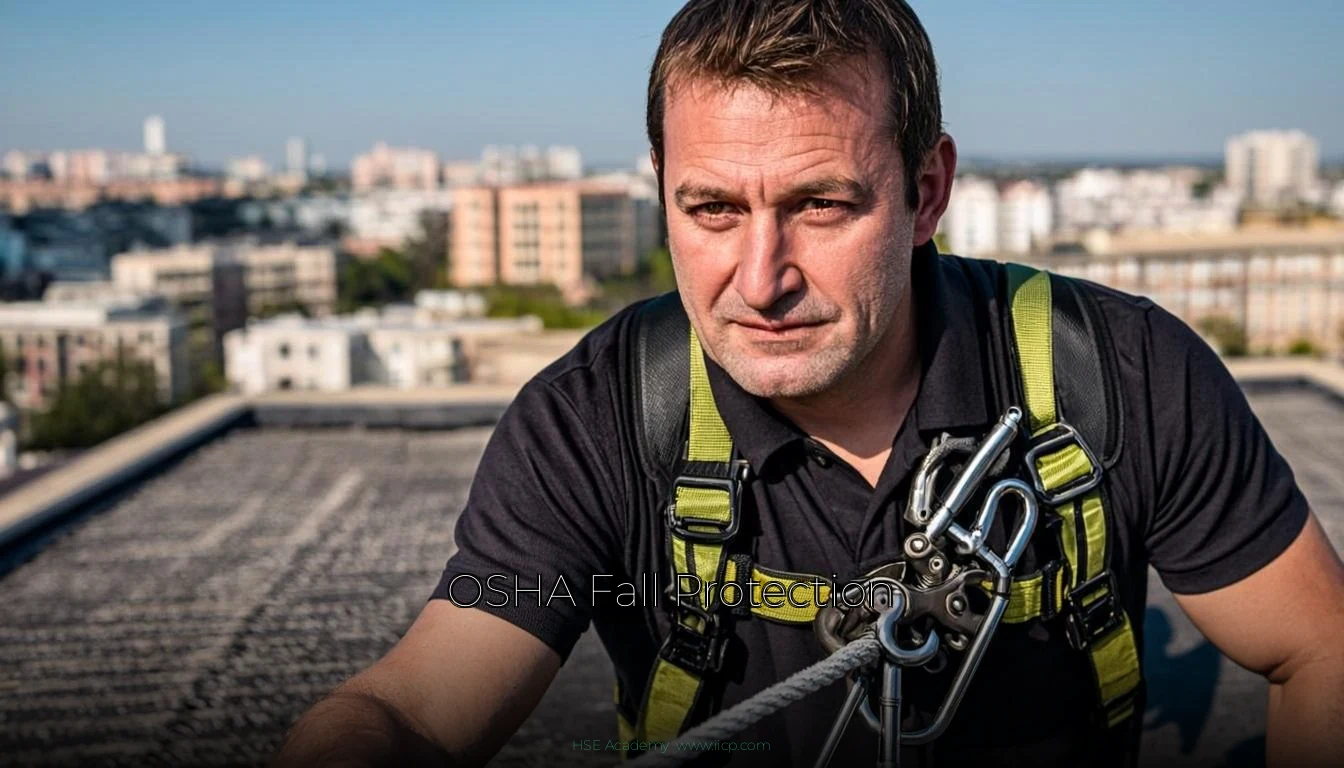
OSHA Fall Protection: Requirements for Working at Height
In the United States, OSHA generally requires fall protection at 6 feet (1.8 metres) in the construction industry. This article outlines the main requirements of 29 CFR 1926.501 and 1926.502 governing work at height.
Introduction
Fall protection is a major priority for the Occupational Safety and Health Administration (OSHA), the US federal agency responsible for occupational safety and health. In the construction industry, falls are among the leading causes of fatal workplace accidents.
This article presents the main requirements of Subpart M of 29 CFR Part 1926, which governs fall protection in the US construction industry. These provisions also serve as a technical reference for HSE professionals in Morocco and internationally, without replacing applicable national legislation.
The trigger threshold: 6 feet (1.8 metres)
Under 29 CFR 1926.501, workers exposed to a fall hazard of 6 feet (1.8 metres) or more above a lower level must be provided with appropriate protection for the work being performed. The systems specified by the regulation include:
- Guardrail systems.
- Safety net systems.
- Personal fall arrest systems.
The required system depends on the work situation and the specific provisions applicable to each activity.
Important: The 6-foot threshold applies to several situations in the construction industry covered by 29 CFR Part 1926. In US general industry, 29 CFR Part 1910 establishes different requirements depending on the activity and the hazards involved; a 4-foot (1.2-metre) threshold applies to certain work situations.
In Morocco, the US threshold must not be treated as a national legal requirement. Risk assessments must consider the worksite configuration, the nature of the task, the equipment used and the potential consequences of a fall. The Moroccan Labour Code, particularly the provisions relating to occupational hygiene and employee safety, provides a general framework that must be supplemented by the regulations applicable to the activity concerned.
Hazardous situations covered
29 CFR 1926.501 identifies situations in which fall protection is required. The main examples include:
- Unprotected sides and edges of working surfaces.
- Leading edges during construction activities.
- Hoist areas, when the conditions specified by the regulation are met.
- Holes and openings, including floor openings and skylights. Appropriate protection must prevent workers from falling through openings and, where applicable, prevent objects from falling through them.
- Roofing work on low-slope roofs, in accordance with the specific applicable provisions.
- Work on steep roofs, requiring appropriate protective measures.
Protection must be determined according to the actual risk and the precise requirements of the relevant regulatory provision.
Fall protection system requirements
1. Guardrails — 29 CFR 1926.502(b)
Guardrails must meet the technical requirements of the standard, including:
- Top rail height: generally between 39 and 45 inches, approximately 99 to 114 cm above the working surface.
- Midrail: installed where required to reduce the risk of workers passing through or falling over the system.
- Strength: the top rail must generally withstand a force of at least 200 pounds-force, approximately 890 newtons, applied downward or outward.
- Safe design: components must not have hazardous projections that could cause injuries.
Installation must also account for the worksite configuration and the other technical criteria specified in the standard.
2. Personal fall arrest systems — 29 CFR 1926.502(d)
A personal fall arrest system consists of compatible components that are correctly selected and used. The main requirements include:
- Full-body harness: the system must use a suitable full-body harness. A body belt alone is not an acceptable personal fall arrest system.
- Anchorage: each anchorage must be capable of supporting at least 5,000 pounds-force (approximately 22.2 kN) per attached worker, or be part of a system designed, installed and used under the supervision of a qualified person in accordance with the standard.
- Arresting force limitation: the system must comply with regulatory limits, including a maximum arresting force of 1,800 pounds-force (approximately 8 kN) for a full-body harness.
- Connectors: snap hooks and other connectors must be compatible, strong and designed to prevent accidental disengagement.
- Component compatibility: the harness, lanyard, energy absorber, connectors and anchorage must function as a coordinated system.
Particular attention must be paid to available clearance below the worker, swing-fall hazards and the ability to rescue a worker promptly after a fall.
3. Safety nets — 29 CFR 1926.502(c)
Safety nets must be installed and used in accordance with regulatory requirements, including:
- Being positioned as close as practicable below the working area, within the limits specified by the standard.
- Meeting the maximum permitted distances between the net and the working surface.
- Having suitable strength and characteristics for their intended use.
- Undergoing inspections and drop tests in accordance with applicable requirements, including before initial use and after certain alterations or repairs.
Safety nets do not replace other preventive measures when a more appropriate collective protection system can be installed.
Mandatory training — 29 CFR 1926.503
Workers exposed to fall hazards must receive training appropriate to the risks they face. Training must cover:
- Recognising fall hazards.
- Procedures for eliminating or reducing those hazards.
- Correct use of fall protection systems.
- Equipment limitations and conditions of use.
- Equipment inspection and defect reporting.
Training must be provided by a competent person as defined by OSHA regulations. Additional training is required when changes in work assignments, equipment or working methods make previously acquired knowledge insufficient.
Application in Morocco and internationally
OSHA regulations are US regulations. Nevertheless, they can serve as a technical reference for Moroccan companies' prevention programmes, particularly when international clients impose specific HSE requirements.
In Morocco:
- Companies must identify the legal obligations applicable to their industry and activities, then implement appropriate preventive measures.
- The Moroccan Labour Code (Law No. 65-99) provides a general framework for occupational hygiene and safety. Specific requirements relating to work at height must be verified against the applicable regulations.
- ISO 45001:2018 can help structure an occupational health and safety management system, particularly hazard identification, risk assessment and monitoring of preventive measures.
- INRS guidance provides practical recommendations for preventing falls from height and prioritising collective protection wherever practicable.
- For personal fall protection equipment, several European standards can serve as technical references: EN 363 for personal fall protection systems, EN 361 for full-body harnesses, EN 354 for lanyards, EN 355 for energy absorbers, EN 360 for retractable-type fall arresters, and EN 365 for general requirements concerning instructions, maintenance and periodic examination.
These references must be used alongside risk assessments and the regulatory obligations that actually apply to the work being performed.
Conclusion
Subpart M of 29 CFR Part 1926 establishes a detailed framework for fall protection in the US construction industry. It specifies situations requiring protection, the characteristics of guardrails, personal fall arrest systems and safety nets, and training obligations.
For HSE professionals in Morocco, these provisions provide a useful technical reference, provided they are distinguished from national legal requirements and adapted to the actual risks present on site. The priority remains hazard prevention at source, the use of collective protection and the implementation of suitable fall protection systems that are inspected regularly and supported by an effective rescue procedure.
Official sources and references
https://www.osha.gov/laws-regs/regulations/standardnumber/1926/1926.501
https://www.inrs.fr/risques/chutes-hauteur/reglementation-travail-hauteur.html
https://natlex.ilo.org/dyn/natlex2/r/natlex/fe/details?p3_isn=67319