
Working at Height in Morocco: Regulation and Fall Prevention
Working at height (scaffolds, roofs, platforms) is one of the leading causes of fatal accidents in Morocco. This article presents legal obligations, PPE and collective prevention measures.
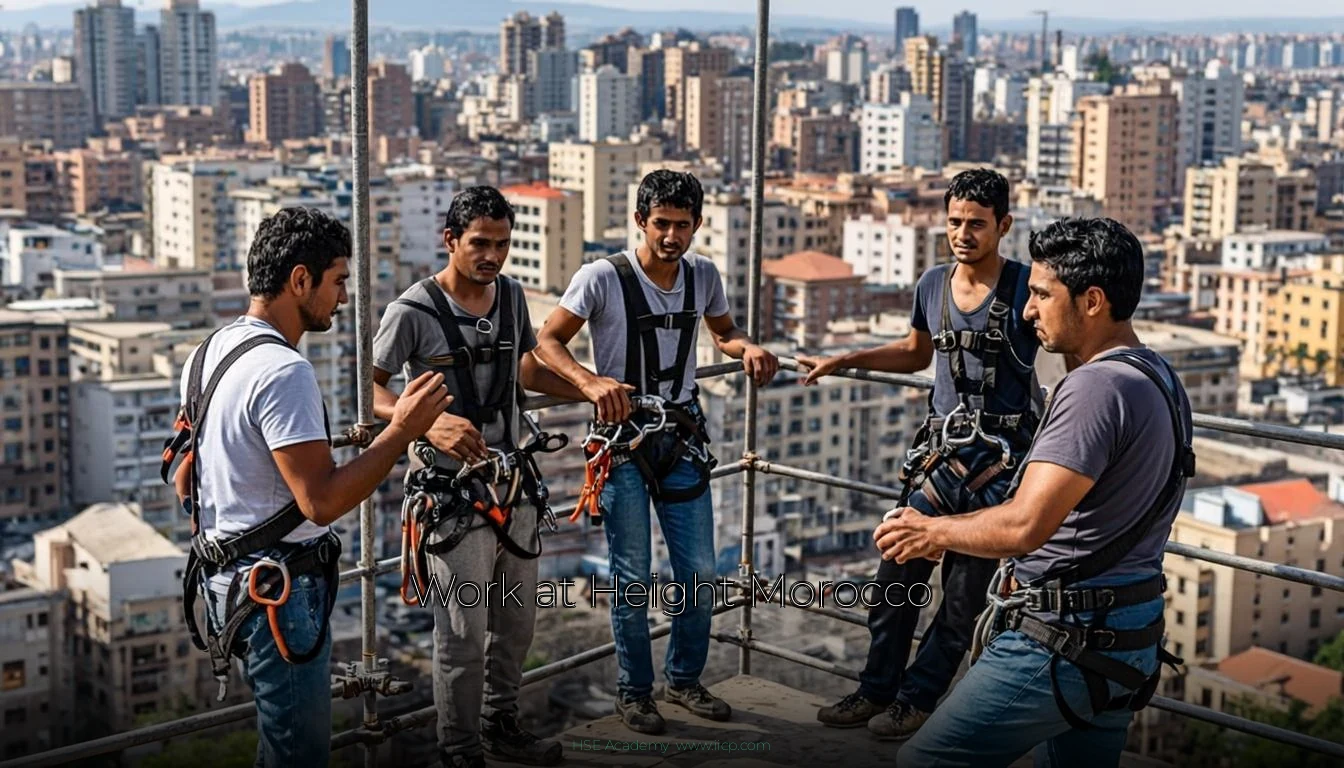
Working at Height in Morocco: Regulations and Fall Prevention
Falls from height can cause serious injuries, permanent disabilities or fatalities. Prevention relies on risk assessment, prioritising collective protection, selecting appropriate equipment and training workers.
Working at height refers to any work situation in which a person is exposed to the risk of falling to a lower level. This risk may arise when working on a roof, scaffold, platform, ladder, mobile elevating work platform or near an opening in a floor.
There is no single height threshold that defines every hazardous situation. Even a fall from a relatively low height can cause serious injuries. Prevention must therefore take account of the work area, the nature of the task, the surrounding environment and the potential consequences of a fall.
In construction, industry, maintenance and public works, fall prevention must be integrated into work planning and site organisation.
1. Definition and regulatory framework in Morocco
Working at height falls within the general principles of occupational risk prevention.
In Morocco, the Labour Code, established by Law No. 65-99, promulgated by Dahir No. 1-03-194 of 14 Rajab 1424 (11 September 2003), includes Title IV, “Occupational Hygiene and Safety,” which sets out various employer obligations relating to occupational health and safety.
Articles 281 and following should be examined to determine which provisions apply to the situation concerned. Specific measures must also be identified in relevant regulatory texts, depending on the sector, equipment used and nature of the work.
It is important to distinguish Moroccan legal provisions from European technical standards and recommendations issued by foreign organisations. These references can help establish good practices, but they do not automatically become legal obligations in Morocco.
As part of fall prevention, a company should, in particular:
- Identify situations that present a risk of falling.
- Assess risks before work begins and whenever conditions change.
- Select work equipment suited to the task and environment.
- Prioritise collective protection whenever it can effectively prevent falls.
- Inform and train workers about the hazards and safe working methods.
- Provide suitable personal protective equipment (PPE) whenever necessary.
- Organise access, movement and work activities to minimise exposure to hazards.
- Establish emergency and rescue procedures appropriate to the risks and available resources.
Specific obligations must be verified against current legislation and the characteristics of each work activity.
2. Planning work at height
Before any work begins, the company must analyse the working conditions and determine the measures needed to prevent falls.
The assessment should consider:
- The working height and the potential consequences of a fall.
- The strength and condition of the surfaces on which workers will operate.
- The presence of floor openings, voids, unprotected edges or fragile surfaces.
- The means of access to the work area.
- Weather conditions, particularly wind and rain.
- The proximity of electrical installations and other hazards.
- The presence of other contractors and risks arising from simultaneous activities.
- The available evacuation and rescue arrangements.
Where possible, the need to work at height should be eliminated. For example, some operations can be carried out from ground level or with tools that allow work to be performed remotely.
When working at height is unavoidable, the company must select a working method and equipment that reduce the risk of falling as far as reasonably practicable.
3. Scaffolding: selection, assembly and inspection
Scaffolding must be suitable for the intended work, required height, loads to be supported and site configuration.
Installation must comply with the manufacturer's instructions, relevant technical requirements and applicable regulations. For example, the EN 12810 series covers certain prefabricated component façade scaffolds. It is a technical reference for equipment within its scope, not a universal regulation covering every situation.
Key safety measures
- Install scaffolding on a suitable, stable surface capable of supporting the expected loads.
- Check structural stability and install the necessary stabilising devices.
- Provide suitable working platforms that are correctly positioned and secured.
- Ensure safe access to each level.
- Install guardrails, intermediate protection and toe boards where required by the configuration and applicable requirements.
- Observe load limits and avoid excessive accumulation of materials.
- Prevent unauthorised access to hazardous areas.
- Prohibit improvised alterations and uncontrolled removal of safety components.
Assembly, dismantling and alterations must be carried out by competent workers trained for the tasks concerned and appropriately supervised.
Scaffolding must be checked before being put into service and after any modification or event that could compromise its stability. Additional inspections should be organised according to applicable requirements, manufacturer instructions and the risk assessment.
Inspection records must be maintained whenever required by applicable legislation or company procedures. A fixed interval, such as an inspection every three months, should not be presented as a universal legal requirement in Morocco without a specific regulatory reference.
4. Mobile elevating work platforms
Mobile elevating work platforms (MEWPs) provide access to elevated work areas. Their safe use requires knowledge of the equipment, its operating limits and the hazards present at the worksite.
Before starting work, the following checks should be carried out:
- Inspect the platform and its safety devices.
- Assess ground stability and identify slopes, holes or obstacles.
- Observe the permitted load and maximum number of occupants.
- Assess wind and other weather-related risks.
- Keep the platform away from power lines and other identified hazards.
- Restrict access to the work area when necessary.
- Ensure that operators understand the normal controls and emergency procedures.
Operators must receive training appropriate to the equipment used and must be authorised to operate it whenever required by applicable regulations.
In France, CACES R.486A is a recommendation relating to the assessment of knowledge and practical skills for the safe operation of MEWPs. It is not an international certification and should not be presented as a general legal requirement in Morocco.
Companies must determine the applicable competency and authorisation requirements by considering local regulations and the conditions under which the equipment is used.
5. Personal fall protection equipment
Personal protective equipment (PPE) for fall protection must be selected according to the risk assessment and the chosen working method. It should not replace collective protection where an appropriate collective system can be installed.
Two main functions must be distinguished:
- Work restraint: prevents the worker from reaching an area where a fall could occur.
- Fall arrest: stops a fall if one occurs, while limiting its consequences for the worker as far as possible.
A fall-arrest system is more than a harness. It consists of compatible components selected for the situation and used in accordance with their instructions.
Main equipment
- Full-body fall-arrest harness: a harness compliant with EN 361 may be used as part of a suitable fall-arrest system.
- Anchorage device: must be suitable for the supporting structure, the system used and the foreseeable forces. Its design and strength must be justified in accordance with applicable requirements.
- Lanyard and energy absorber: an EN 354-compliant lanyard may be combined with an EN 355-compliant energy absorber when required by the system.
- Retractable fall arrester: relevant devices are covered by EN 360.
- Protective helmet: must be selected according to the identified hazards. A chin strap may be necessary to reduce the risk of losing the helmet.
These standards are European technical references. Their relevance and any applicable recognition must be checked against the equipment, contractual requirements and regulatory framework in Morocco.
Inspection and use of PPE
Before each use, workers must examine the equipment in accordance with the manufacturer's instructions and report any defects.
Periodic inspections must be carried out by a competent person, taking account of the manufacturer's instructions, equipment condition and applicable requirements.
Any equipment that is damaged, suspected to be defective or has been involved in a fall must be immediately withdrawn from service. It must not be reused until it has been dealt with in accordance with the manufacturer's instructions and applicable requirements.
Selecting a fall-arrest system also requires consideration of:
- Clearance distance: the space required to arrest a fall without striking an obstacle.
- The risk of a pendulum fall.
- Compatibility between system components.
- The strength of the supporting structure and anchorage device.
- Operating conditions and the manufacturer's specified limits.
- The possibility of promptly rescuing a worker after a fall.
A rescue plan is essential whenever the use of a fall-arrest system exposes a worker to the risk of remaining suspended after a fall.
6. Collective protection: the priority
Collective protection should be prioritised whenever it can effectively prevent falls. It protects workers without relying solely on the correct wearing and use of individual PPE.
The main systems include:
- Guardrails: prevent accidental access to edges and reduce the risk of falling.
- Safe working platforms: provide a stable surface suitable for the task.
- Opening covers and barriers: prevent falls into floor openings, shafts and other voids.
- Safety nets: may reduce the consequences of a fall when suitable for the situation.
- Safe permanent access systems: allow workers to reach elevated work areas without unnecessary exposure to hazards.
Guardrails must be designed and installed in accordance with applicable technical requirements. EN 13374 covers certain temporary edge protection systems, particularly on construction sites. The characteristics of the system must be suitable for the configuration and conditions of use.
Safety nets may fall within the EN 1263 series where applicable. EN 795 covers certain anchorage devices intended for personal fall protection equipment.
None of these standards replaces a comprehensive risk assessment, verification of component compatibility or compliance with local regulatory requirements.
7. Work planning, coordination and site organisation
Planning work at height must specify the identified hazards, preventive measures, responsibilities, access arrangements and rescue procedures.
When several companies operate at the same site, coordination should address:
- Risks arising from simultaneous or sequential activities.
- Access routes and movement around the site.
- Demarcation of hazardous areas.
- Shared use of equipment.
- Prevention of falling objects that could injure other workers.
- Alert, evacuation and rescue procedures.
Depending on the country and circumstances, this organisation may take the form of a prevention plan, risk assessment, safe work method statement or equivalent document.
The term “prevention plan” and its mandatory status should be used only where the applicable regulations require it. The relevant Moroccan requirements must be checked before stating that a particular document is legally compulsory.
8. Worker training and competence
Training is essential to preventing falls from height. It must be adapted to the tasks performed, equipment used and hazards present at the worksite.
Training may cover:
- Identifying hazardous situations.
- Selecting and using work equipment.
- Safely assembling, using and dismantling scaffolding, according to the worker's responsibilities.
- Operating MEWPs where this forms part of the worker's duties.
- Wearing, adjusting and inspecting fall protection PPE.
- Understanding equipment limitations.
- Preventing falling objects.
- Emergency and rescue procedures following a fall.
Companies must verify workers' competence and provide appropriate supervision. A training certificate or qualification issued in another country should not automatically be considered sufficient to satisfy every requirement applicable in Morocco.
Workers must also understand when work should be stopped, particularly when weather conditions, equipment defects or the surrounding environment make safe working impossible.
9. Equipment inspection and monitoring of preventive measures
Companies must organise the monitoring of equipment used for work at height.
This may include:
- Pre-use checks.
- Periodic inspections appropriate to the equipment.
- Preventive maintenance.
- Records of identified defects and repairs.
- Withdrawal of defective equipment from service.
- Verification of appropriate PPE storage conditions.
- Investigation of incidents and implementation of corrective actions.
The type and frequency of inspections must be determined according to applicable requirements, manufacturer instructions and the risks associated with each item of equipment.
Inspection intervals established by other countries' regulations should not automatically be applied in Morocco. Whenever a specific interval is presented as a legal obligation, it should be supported by a reference to the applicable legislation.
10. Conclusion
Preventing falls from height requires a structured approach that begins before work starts and continues throughout the activity.
Risk assessment, appropriate equipment selection, priority for collective protection, worker training and rescue planning are the main elements of an effective prevention strategy.
In Morocco, preventive measures must be defined with reference to the Labour Code, the regulations applicable to the activity and the characteristics of the equipment used. European standards and foreign recommendations can provide useful technical guidance, but they must be clearly distinguished from Moroccan legal obligations.
Ultimately, safety depends on the company's ability to inspect its equipment, correct hazardous conditions and stop work whenever conditions no longer allow it to be performed safely.
Sources and references
-
Kingdom of Morocco — Labour Code, Law No. 65-99. Legal reference for provisions concerning occupational hygiene and employee safety, particularly Title IV. The scope of the obligations must be checked against the articles applicable to each situation.
https://adala.justice.gov.ma/api/uploads/2024/04/30/code%20du%20travail-1714463246806.pdf -
French National Research and Safety Institute (INRS) — Risks associated with falls from height: regulations and prevention. Technical guidance on risk assessment, collective protection, work equipment, PPE and training. French legal provisions described by this organisation must not automatically be treated as Moroccan law.
https://www.inrs.fr/risques/chutes-hauteur/reglementation-travail-hauteur.html