
Workplace Lighting and Vision: Preventing Visual Fatigue
Inadequate workplace lighting causes visual fatigue, headaches and errors. Lux levels vary by task. This article covers thresholds, lighting types and prevention measures.
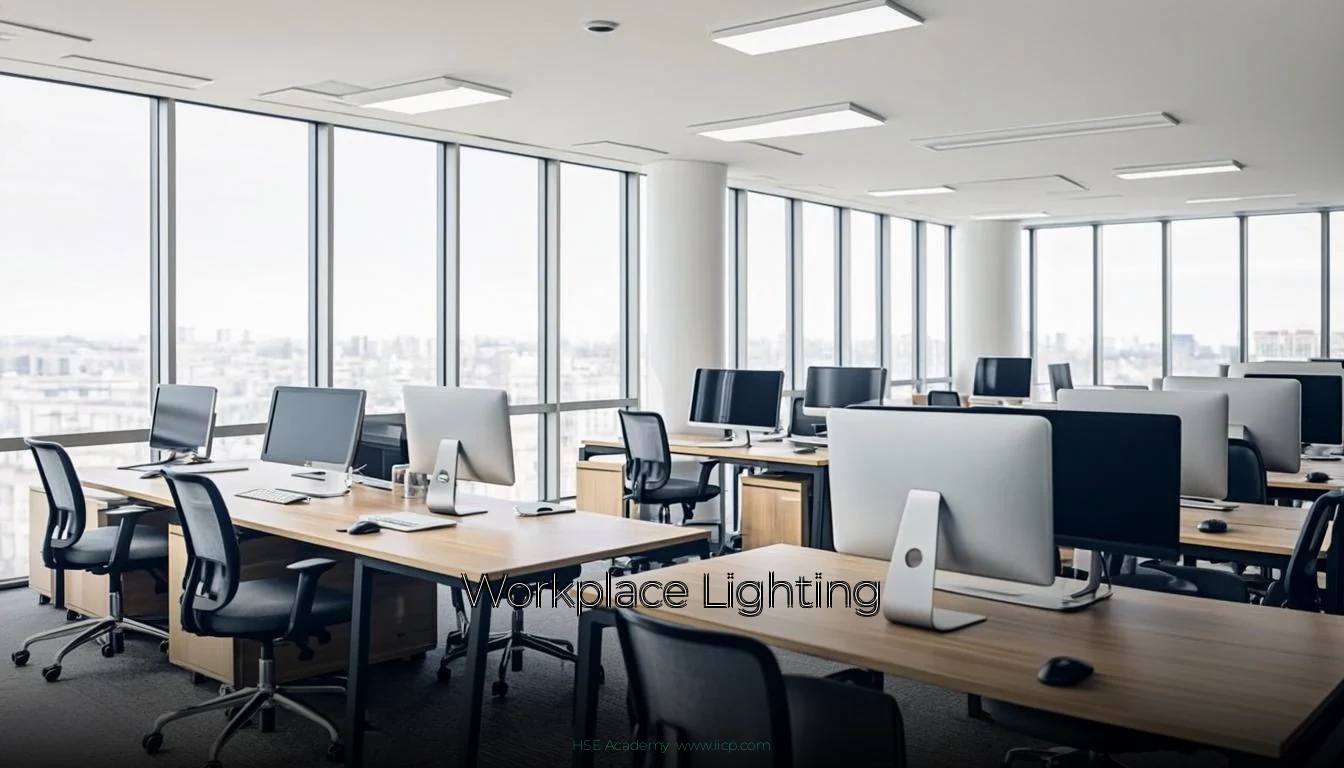
Vision and Lighting at Work: Prevention of Visual Fatigue
Inappropriate lighting causes visual fatigue, headaches, and errors. Illuminance standards (in lux) vary by activity. This article presents thresholds, lighting types, and prevention.
Inappropriate lighting in the workplace is a major cause of visual fatigue, headaches, errors, and even accidents. The prevention of visual risk relies on adherence to illuminance thresholds (in lux), control of glare, and regular maintenance of luminaires. This article presents the normative thresholds and good HSE practices.
Health and Safety Implications
Insufficient or poorly designed lighting causes:
- Visual fatigue: Stinging, blurred vision, dry eyes.
- Headaches and musculoskeletal disorders (strained postures to compensate).
- Errors and accidents: Poor perception of obstacles, tools, and defects.
- Decreased productivity and absenteeism.
Illuminance Standards (EN 12464-1)
The European standard EN 12464-1 Light and lighting — Lighting of work places — Part 1: Indoor work places defines maintained minimum illuminance levels based on activity. Some reference values:
- Offices, writing, data entry: 500 lux.
- Meeting rooms, circulation areas: 200 lux.
- General mechanical workshops: 500 lux.
- Precision work, quality control, technical drawing: 750 to 1000 lux.
- Internal circulation zones: 100 to 150 lux.
- Outdoors, parking lots, traffic routes: 20 to 50 lux.
The standard provides multiplication factors for areas occupied by visually impaired persons or for demanding tasks. for screen-based work, the INRS recommends a specific illuminance of 300 to 500 lux (light-colored screens) or 200 to 300 lux (dark-colored screens).
Types of Lighting
Three main types coexist in the professional environment:
- Natural lighting: Daylight via windows, rooflights, light wells. Recommended as a priority, it improves visual and psychological comfort.
- Artificial lighting: LED, fluorescent, halogen. LEDs are now preferred (long lifespan, low consumption, good color rendering index CRI > 80).
- Mixed lighting: A combination of both, with artificial supplementation when natural light is insufficient.
Glare (UGR)
The Unified Glare Rating (UGR) is an index that characterizes the direct glare of an installation. The EN 12464-1 standard sets limits depending on the activity:
- Screen-based offices: UGR < 19.
- General workshops: UGR < 22.
- Drawing rooms, fine inspection: UGR < 16.
To limit glare: luminaires with anti-glare optics, lateral positioning relative to the field of vision, blinds and frosted glass on windows.
Prevention and Screen Work
- Maintenance of luminaires (dusting, replacement of tubes at end-of-life).
- Visual correction: Regular eye exams, glasses adapted for screen work.
- Workstation: Screen at 50-70 cm from eyes, eye level, tilt of 10-20°. The ISO 9241 standard (ergonomics of human-system interaction, parts on screens) governs screen ergonomics.
- Visual breaks: The 20-20-20 rule (every 20 minutes, look at 20 feet / 6 m for 20 seconds).
Sources et références
-
Code du travail marocain (Loi n° 65-99), Titre IV — articles 281 et suivants (principes généraux applicables à l'éclairage) ILO NATLEX : https://natlex.ilo.org/dyn/natlex2/r/natlex/fe/details?p3_isn=67319
-
INRS — Travail sur écran : Prévention des risques (URL vérifiée 24/10/2026) https://www.inrs.fr/risques/travail-ecran/prevention-risques.html
-
INRS — Éclairage : concilier sobriété énergétique et santé (article actualités) https://www.inrs.fr/actualites/eclairage-sobriete-energetique-sst.html