Workplace Welding: Fume, UV Risks and HSE Prevention
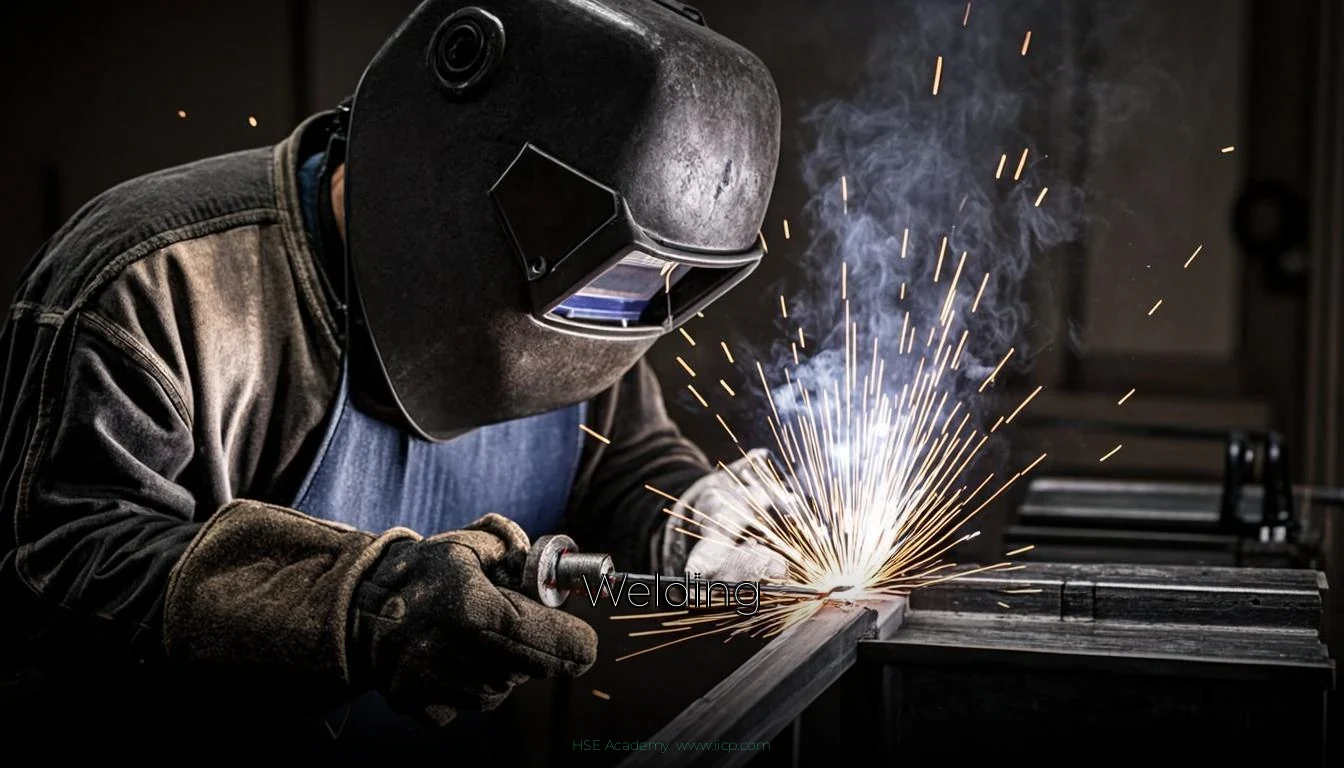
Welding generates specific risks: toxic fumes, UV/IR radiation, burns, noise and electromagnetic fields. This article covers prevention measures and welding PPE.
Welding at Work: Fume, UV Radiation and HSE Prevention
1. Main Welding Processes
Welding is used to join metal components through heat, pressure, or a combination of both. The main processes include:
- MIG welding: uses an inert shielding gas.
- MAG welding: uses an active shielding gas.
- TIG welding: uses a non-consumable tungsten electrode and shielding gas.
- Shielded metal arc welding: uses a flux-coated electrode.
- Resistance welding: generates heat through electrical resistance and pressure.
Oxy-fuel cutting and plasma cutting are metal-cutting processes rather than welding processes, although they can involve similar occupational hazards.
2. Welding Fumes and Health Risks
Welding fumes are generated when metals and other materials are heated to high temperatures and vaporize, then condense into fine particles. Their composition depends on the base metal, filler materials, coatings, welding process and operating conditions.
Exposure may cause:
- Irritation of the respiratory tract and eyes.
- Acute effects, including metal fume fever in certain circumstances.
- Respiratory diseases, depending on the substances involved and the level and duration of exposure.
- Long-term health effects, including cancer.
The International Agency for Research on Cancer (IARC) classifies welding fumes and ultraviolet radiation from welding as Group 1 carcinogens, meaning that there is sufficient evidence that they can cause cancer in humans. This classification does not mean that every individual metal or metal oxide present in welding fumes is itself classified in the same way.
Particular attention is required when welding stainless steel, galvanized metals, painted surfaces or materials containing hazardous coatings. The risks must be assessed according to the actual substances involved.
3. Ultraviolet and Infrared Radiation
The welding arc emits intense visible light, ultraviolet (UV) radiation and infrared (IR) radiation.
Potential effects include:
- UV radiation: eye injuries such as arc eye, as well as skin burns.
- Visible radiation: eye discomfort and potential retinal damage from intense exposure.
- IR radiation: thermal effects on the eyes and skin.
Appropriate welding helmets, correctly selected filters, protective clothing and screens are essential. Screens should also protect nearby workers from direct and reflected arc radiation.
4. Other Occupational Hazards
Welding activities may also involve:
- Burns: caused by hot metal, sparks, molten material and heated equipment.
- Noise: particularly during grinding, cutting and certain industrial processes.
- Electric shock: especially when equipment, cables or connections are damaged or when work takes place in damp conditions.
- Electromagnetic fields: workers with pacemakers or other implanted medical devices should receive an individualized assessment and follow the device manufacturer's guidance.
- Fire and explosion: caused by sparks, hot work near combustible materials, flammable gases or inadequate control of the surrounding area.
The risk assessment must consider the work environment, materials, equipment and simultaneous activities.
5. Preventing Exposure to Welding Fumes
Prevention should prioritize eliminating or reducing exposure at its source.
Local exhaust ventilation
Local exhaust ventilation should capture fumes as close as possible to the point where they are generated. Its effectiveness depends on the hood design, airflow, positioning and working conditions.
General ventilation
General ventilation can help control residual contamination, but it should not replace effective source capture when local exhaust ventilation is required.
Confined spaces
Welding in tanks, vessels or other confined spaces requires specific planning. Before work begins, assess atmospheric hazards, oxygen levels where relevant, ventilation, access, emergency arrangements and the need for atmospheric monitoring.
Never rely on ventilation alone when the risk assessment identifies additional controls as necessary.
6. Personal Protective Equipment
Personal protective equipment (PPE) must be selected according to the risk assessment and the welding process.
- Welding helmet: fitted with a suitable filter shade for the process and operating conditions.
- Eye protection: appropriate protection for welding, grinding and related activities.
- Respiratory protection: selected according to the contaminants, exposure levels and working conditions. A P3 particulate filter can protect against suitable airborne particles, but it does not provide protection against every gas or vapour.
- Protective gloves: resistant to heat and suitable for the task.
- Protective clothing: designed to reduce exposure to sparks, molten metal and ultraviolet radiation.
- Safety footwear: suitable for the workplace and the risk of hot materials or falling objects.
- Hearing protection: used where the noise assessment indicates that it is necessary.
Respiratory protective equipment must not be treated as a substitute for effective engineering controls when those controls are feasible and required.
7. Work Organization and Hot-Work Permits
Before welding begins, the work area should be inspected and combustible materials removed or adequately protected. Gas cylinders, electrical equipment and welding cables must be handled and maintained safely.
A hot-work permit may be required under the site's procedures, contractual requirements or applicable regulations. It should not be presented as a universal legal requirement for every welding operation.
Depending on the risk, preventive measures may include:
- Checking the work area before starting.
- Isolating flammable materials and controlling ignition sources.
- Providing suitable fire-extinguishing equipment.
- Assigning fire-watch personnel where necessary.
- Monitoring the area during the work and for an appropriate period afterward.
- Establishing emergency procedures and ensuring that workers understand them.
The required controls should be determined by the risk assessment and the applicable rules.
8. Training, Exposure Assessment and Health Surveillance
Workers should receive appropriate training in the welding process, equipment use, hazard recognition, ventilation, PPE and emergency procedures.
Employers should assess exposure where necessary and verify that preventive measures remain effective. Depending on the substances involved and the applicable requirements, this may include exposure monitoring and occupational health surveillance.
Medical surveillance requirements must be determined according to the relevant legal framework, occupational exposures and individual circumstances. It should not be assumed that identical enhanced medical examinations are required for every welder.
9. Regulatory Context in Morocco
In Morocco, occupational risk prevention must be considered in light of the Moroccan Labour Code, particularly Law No. 65-99, together with any other applicable requirements.
Technical publications from the French National Research and Safety Institute (INRS), European standards and international guidance can provide useful preventive recommendations. However, they must not automatically be presented as binding Moroccan legal requirements.
Employers should identify the provisions applicable to their workplace, assess the risks associated with welding activities and implement suitable preventive measures.
Conclusion
Welding can expose workers to carcinogenic fumes, ultraviolet radiation, burns, electric shock and fire hazards. Effective prevention combines risk assessment, source-capture ventilation, suitable protective equipment, safe work organization, worker training and appropriate exposure control.
The measures must be adapted to the welding process, the materials used and the actual conditions in the workplace.
Sources
-
International Labour Organization (ILO) — Moroccan Labour Code, Law No. 65-99:
https://natlex.ilo.org/dyn/natlex2/r/natlex/fe/details?p3_isn=67319 -
French National Research and Safety Institute (INRS) — Welding fumes: key points:
https://www.inrs.fr/risques/fumees-soudage/ce-qu-il-faut-retenir.html -
International Agency for Research on Cancer (IARC) — Volume 118:
https://monographs.iarc.who.int/news-events/volume-118-tlo/